Ch. 7 - Structure and Synthesis of Alkenes; Elimination
Wade - Organic Chemistry 9th Edition
Wade9th EditionOrganic ChemistryISBN: 9780135213728Not the one you use?Change textbook
Chapter 7, Problem 30b

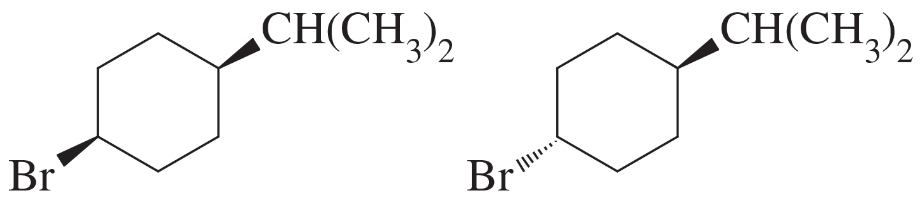
Predict which of the following compounds will undergo elimination with KOH faster, and explain why. Predict the major product that will be formed.

Verified step by step guidance
1
Step 1: Analyze the structures of the two compounds. Both are cyclohexane derivatives with a bromine atom and an isopropyl group attached. The difference lies in the stereochemistry of the bromine atom: one is in the axial position, and the other is in the equatorial position.
Step 2: Recall the mechanism of elimination (E2) with KOH. For E2 elimination, the anti-periplanar geometry is crucial. The β-hydrogen and the leaving group (Br) must be in opposite planes (anti-periplanar) for the elimination to occur efficiently.
Step 3: Evaluate the stereochemistry of the β-hydrogens relative to the bromine atom in each compound. In the compound with axial bromine, the β-hydrogens on adjacent carbons are equatorial, making them anti-periplanar to the bromine. In the compound with equatorial bromine, the β-hydrogens are axial, which are not anti-periplanar to the bromine.
Step 4: Predict which compound will undergo elimination faster. The compound with axial bromine will undergo elimination faster because the anti-periplanar geometry is readily achieved, whereas the equatorial bromine does not have β-hydrogens in the correct orientation for efficient elimination.
Step 5: Predict the major product formed. The elimination reaction will result in the formation of a double bond between the carbon bearing the bromine and one of the adjacent carbons. The major product will be determined by Zaitsev's rule, favoring the more substituted alkene.

Verified video answer for a similar problem:

This video solution was recommended by our tutors as helpful for the problem above.
Video duration:
8m
Was this helpful?

Key Concepts

Here are the essential concepts you must grasp in order to answer the question correctly.

Elimination Reactions

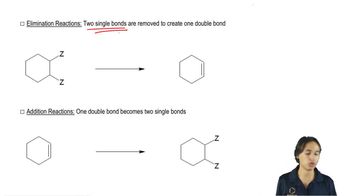
Elimination reactions involve the removal of a leaving group and a hydrogen atom from adjacent carbon atoms, resulting in the formation of a double bond. The most common types are E1 and E2 mechanisms, which differ in their reaction conditions and mechanisms. Understanding the conditions that favor each mechanism is crucial for predicting the rate and products of elimination reactions.
Recommended video:
Guided course
00:40
Recognizing Elimination Reactions.

Sterics and Substitution Patterns

Steric hindrance refers to the spatial arrangement of atoms that can affect the reactivity of a molecule. In elimination reactions, more substituted carbon atoms tend to favor E2 mechanisms due to their ability to stabilize the transition state. Recognizing the steric effects of substituents on the carbon chain is essential for predicting which compound will undergo elimination faster.
Recommended video:
Guided course
08:06
Common Splitting Patterns

Regioselectivity in Elimination

Regioselectivity refers to the preference of a chemical reaction to yield one structural isomer over others. In elimination reactions, the major product often forms from the more stable alkene, which is influenced by factors such as substitution and steric effects. Understanding the concept of regioselectivity helps in predicting the major product formed during the elimination process.
Recommended video:
Guided course
00:38
Intro to Substitution/Elimination Problems