Ch. 7 - Structure and Synthesis of Alkenes; Elimination
Wade - Organic Chemistry 9th Edition
Wade9th EditionOrganic ChemistryISBN: 9780135213728Not the one you use?Change textbook
Chapter 7, Problem 28b

Predict the elimination products of the following reactions, and label the major products.
b. trans-1-bromo-2-methylcyclohexane + NaOCH3 in CH3OH

Verified step by step guidance
1
Analyze the substrate: The given compound is trans-1-bromo-2-methylcyclohexane, which is a cyclohexane ring with a bromine atom at position 1 and a methyl group at position 2. The bromine and methyl groups are in a trans configuration, meaning they are on opposite sides of the ring.
Identify the reaction type: The presence of NaOCH3 (a strong base) in CH3OH (a polar protic solvent) suggests that this is an E2 elimination reaction. E2 reactions are concerted, meaning the base abstracts a proton while the leaving group (bromine) departs simultaneously.
Determine the β-hydrogens: In an E2 reaction, the base abstracts a β-hydrogen (a hydrogen atom on a carbon adjacent to the carbon bearing the leaving group). For trans-1-bromo-2-methylcyclohexane, the β-carbons are the carbons adjacent to the carbon bonded to bromine. Check the axial and equatorial positions of the β-hydrogens to determine which are anti-periplanar to the bromine.
Predict the elimination products: The anti-periplanar geometry is required for E2 elimination. In the chair conformation of trans-1-bromo-2-methylcyclohexane, the bromine atom and a β-hydrogen must be in opposite planes (one axial up and the other axial down). Identify the possible β-hydrogens that meet this requirement and predict the resulting alkenes. Consider Zaitsev's rule, which states that the more substituted alkene is typically the major product.
Label the major product: Based on Zaitsev's rule, the major product will be the more substituted alkene (the one with the greater number of alkyl groups attached to the double bond). Label the major and minor products accordingly.

Verified video answer for a similar problem:

This video solution was recommended by our tutors as helpful for the problem above.
Video duration:
8m
Was this helpful?

Key Concepts

Here are the essential concepts you must grasp in order to answer the question correctly.

Elimination Reactions

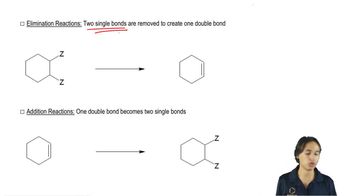
Elimination reactions involve the removal of a small molecule from a larger one, typically resulting in the formation of a double bond. In organic chemistry, these reactions can follow either an E1 or E2 mechanism, depending on the substrate and conditions. Understanding the mechanism is crucial for predicting the products, as it influences the regioselectivity and stereochemistry of the resulting alkenes.
Recommended video:
Guided course
00:40
Recognizing Elimination Reactions.

Stereochemistry

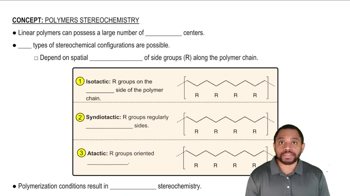
Stereochemistry refers to the spatial arrangement of atoms in molecules and how this affects their chemical behavior. In the case of trans-1-bromo-2-methylcyclohexane, the relative positions of the bromine and methyl groups will influence the elimination pathway and the stereochemical outcome of the reaction. Recognizing the stereochemical implications is essential for accurately predicting the major elimination products.
Recommended video:
1:38
Polymer Stereochemistry Concept 1

Regioselectivity

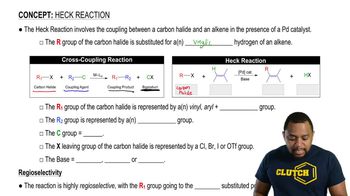
Regioselectivity is the preference of a chemical reaction to yield one structural isomer over others when multiple possibilities exist. In elimination reactions, the stability of the resulting alkene plays a significant role in determining the major product. For trans-1-bromo-2-methylcyclohexane, understanding which alkene is more stable (e.g., more substituted) will help in predicting the major product formed during the reaction with NaOCH3.
Recommended video:
Guided course
05:09
Heck Reaction