Ch. 7 - Structure and Synthesis of Alkenes; Elimination
Wade - Organic Chemistry 9th Edition
Wade9th EditionOrganic ChemistryISBN: 9780135213728Not the one you use?Change textbook
Chapter 7, Problem 29

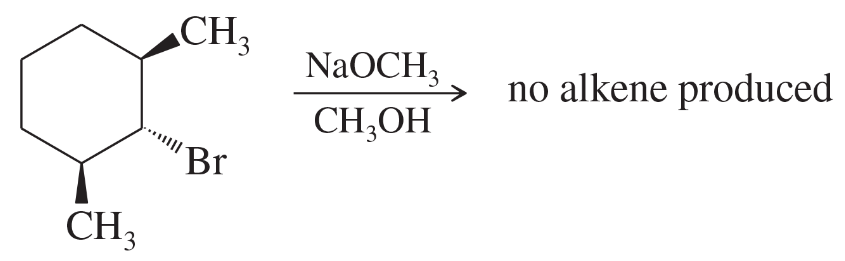
When the following stereoisomer of 2-bromo-1,3-dimethylcyclohexane is treated with sodium methoxide, no E2 reaction is observed. Explain why this compound cannot undergo the E2 reaction in the chair conformation.

Verified step by step guidance
1
Step 1: Recall the requirements for an E2 elimination reaction. For an E2 reaction to occur, the leaving group (in this case, Br) and a β-hydrogen must be anti-periplanar (i.e., they must be in opposite planes and aligned in a staggered conformation). In cyclohexane rings, this typically means the leaving group and β-hydrogen must both occupy axial positions in the chair conformation.
Step 2: Analyze the stereochemistry of the given compound. The bromine atom is in an equatorial position in the chair conformation of 2-bromo-1,3-dimethylcyclohexane. This is evident from the wedge bond indicating equatorial placement.
Step 3: Check the positions of the β-hydrogens. For elimination to occur, there must be a β-hydrogen trans to the bromine atom that can adopt an axial position. However, in this case, the β-hydrogens are in equatorial positions, and no β-hydrogen is anti-periplanar to the bromine.
Step 4: Consider the possibility of conformational flipping. If the chair conformation flips, the bromine would move to an axial position. However, the β-hydrogens would then move to equatorial positions, and the anti-periplanar geometry required for E2 elimination would still not be achieved.
Step 5: Conclude why no E2 reaction occurs. Since the bromine and β-hydrogens cannot simultaneously adopt diaxial (anti-periplanar) positions in any chair conformation, the stereochemical requirements for E2 elimination are not met. Therefore, no alkene is produced under these conditions.

Verified video answer for a similar problem:

This video solution was recommended by our tutors as helpful for the problem above.
Video duration:
5m
Was this helpful?

Key Concepts

Here are the essential concepts you must grasp in order to answer the question correctly.

E2 Reaction Mechanism

The E2 (bimolecular elimination) reaction is a concerted process where a base abstracts a proton while a leaving group departs, resulting in the formation of a double bond. For an E2 reaction to occur, the substrate must have the appropriate geometry, typically requiring an anti-periplanar arrangement of the leaving group and the hydrogen being removed. This spatial requirement is crucial for the reaction to proceed efficiently.
Recommended video:
Guided course
09:36
Drawing the E2 Mechanism.

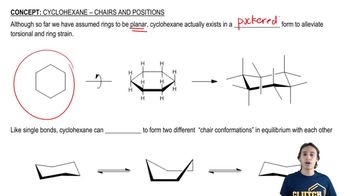
Chair Conformation of Cyclohexane

Cyclohexane can adopt a chair conformation, which minimizes steric strain and allows for staggered interactions between substituents. In this conformation, substituents can occupy axial or equatorial positions. The positioning of groups in the chair conformation significantly affects reactivity; axial substituents are more likely to participate in reactions like E2 due to their favorable orientation relative to hydrogen atoms.
Recommended video:
Guided course
01:05
What is a chair conformation?

Steric Hindrance

Steric hindrance refers to the repulsion between bulky groups that can impede reactions. In the case of 2-bromo-1,3-dimethylcyclohexane, the presence of two methyl groups in axial positions creates significant steric strain, preventing the necessary anti-periplanar arrangement for the E2 reaction. This steric crowding inhibits the approach of the base to abstract the proton, thus preventing alkene formation.
Recommended video:
Guided course
02:53
Understanding steric effects.