


Ch. 7 - Structure and Synthesis of Alkenes; Elimination
Wade - Organic Chemistry 9th Edition
Wade9th EditionOrganic ChemistryISBN: 9780135213728Not the one you use?Change textbook
Chapter 7, Problem 32b

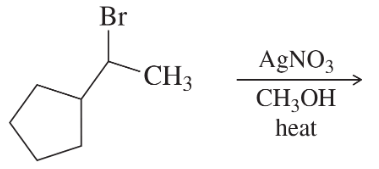
Predict the major and minor elimination products of the following proposed reactions (ignoring any possible substitutions for now). In each case, explain whether you expect the mechanism of the elimination to be E1 or E2.
(b)

Verified step by step guidance
1
Step 1: Analyze the reaction conditions. The presence of AgNO3 in CH3OH (methanol) and heat suggests that the reaction is likely to proceed via an E1 elimination mechanism. AgNO3 helps to remove the bromide ion (Br⁻), forming a carbocation intermediate, which is characteristic of E1 mechanisms.
Step 2: Identify the substrate. The substrate is a cyclopentyl bromide with a methyl group attached to the carbon bearing the bromine atom. This structure allows for the formation of a secondary carbocation upon loss of the bromide ion.
Step 3: Predict the carbocation stability. The secondary carbocation formed after the bromide leaves is relatively stable. Additionally, the methyl group can provide hyperconjugation and inductive effects, further stabilizing the carbocation.
Step 4: Determine the possible elimination products. In an E1 mechanism, elimination occurs by removing a β-hydrogen from a carbon adjacent to the carbocation. This can lead to the formation of alkenes. The major product will likely be the more substituted alkene (Zaitsev's rule), while the minor product will be the less substituted alkene.
Step 5: Consider stereochemistry and regioselectivity. The major product will be the alkene with the double bond between the cyclopentyl ring and the methyl group (more substituted), while the minor product will have the double bond between the cyclopentyl ring and the less substituted β-carbon. No stereospecificity is expected in E1 mechanisms.

Verified video answer for a similar problem:

This video solution was recommended by our tutors as helpful for the problem above.
Video duration:
6m
Was this helpful?

Key Concepts

Here are the essential concepts you must grasp in order to answer the question correctly.

Elimination Reactions

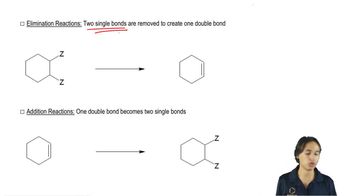
Elimination reactions involve the removal of a leaving group and a hydrogen atom from adjacent carbon atoms, resulting in the formation of a double bond. The two main types are E1 and E2 mechanisms. E1 is a two-step process where the leaving group departs first, forming a carbocation, followed by deprotonation. E2 is a one-step concerted process where the base removes a proton while the leaving group exits simultaneously.
Recommended video:
Guided course
00:40
Recognizing Elimination Reactions.

E1 vs. E2 Mechanisms

The E1 mechanism is favored in polar protic solvents and with substrates that can stabilize carbocations, such as tertiary halides. In contrast, the E2 mechanism requires a strong base and is favored in polar aprotic solvents, typically involving primary or secondary substrates. The choice between E1 and E2 can significantly affect the product distribution and reaction rate.
Recommended video:
Guided course
09:36
Drawing the E2 Mechanism.

Regioselectivity in Elimination

Regioselectivity refers to the preference for the formation of one constitutional isomer over others in a chemical reaction. In elimination reactions, this often results in the formation of more stable alkenes, such as the Zaitsev product, which is the more substituted alkene, or the Hofmann product, which is the less substituted alkene. Understanding regioselectivity is crucial for predicting the major and minor products of elimination reactions.
Recommended video:
Guided course
00:38
Intro to Substitution/Elimination Problems