

Ch. 7 - Structure and Synthesis of Alkenes; Elimination
Wade - Organic Chemistry 9th Edition
Wade9th EditionOrganic ChemistryISBN: 9780135213728Not the one you use?Change textbook
Chapter 7, Problem 33a

Predict the products and mechanisms of the following reactions. When more than one product or mechanism is possible, explain which are most likely.
a. 1−bromohexane + sodium ethoxide in ethanol

Verified step by step guidance
1
Step 1: Recognize the type of reaction. The reaction involves 1-bromohexane (a primary alkyl halide) and sodium ethoxide (a strong base and nucleophile) in ethanol (a polar protic solvent). This setup suggests that both substitution (SN2) and elimination (E2) mechanisms are possible.
Step 2: Analyze the substrate. 1-Bromohexane is a primary alkyl halide, which favors the SN2 mechanism because primary carbons are less sterically hindered, allowing the nucleophile to attack more easily. However, the presence of a strong base like sodium ethoxide also makes elimination (E2) a competing pathway.
Step 3: Consider the nucleophile and solvent. Sodium ethoxide is both a strong nucleophile and a strong base. Ethanol, being a polar protic solvent, can stabilize the transition state for elimination (E2) but may also allow for substitution (SN2) to occur. The balance between these pathways depends on the reaction conditions.
Step 4: Predict the products. For the SN2 pathway, the nucleophile (ethoxide ion) will attack the carbon bonded to the bromine atom, displacing the bromide ion and forming ethoxyhexane. For the E2 pathway, the ethoxide ion will abstract a β-hydrogen (from a carbon adjacent to the carbon bonded to bromine), leading to the formation of 1-hexene as the elimination product.
Step 5: Determine the most likely mechanism. Since 1-bromohexane is a primary alkyl halide, the SN2 mechanism is likely to dominate under these conditions. However, the strong base (sodium ethoxide) and polar protic solvent also make elimination (E2) a viable pathway, especially at higher temperatures. The reaction may yield a mixture of products, with the substitution product (ethoxyhexane) being the major product and the elimination product (1-hexene) being the minor product.

Verified video answer for a similar problem:

This video solution was recommended by our tutors as helpful for the problem above.
Video duration:
1m
Was this helpful?

Key Concepts

Here are the essential concepts you must grasp in order to answer the question correctly.

Nucleophilic Substitution Reactions

Nucleophilic substitution reactions involve the replacement of a leaving group in a molecule by a nucleophile. In this case, sodium ethoxide acts as a nucleophile that can attack the carbon atom bonded to the bromine in 1-bromohexane. Understanding the mechanisms, such as SN1 and SN2, is crucial for predicting the products formed in this reaction.
Recommended video:
Guided course
01:47
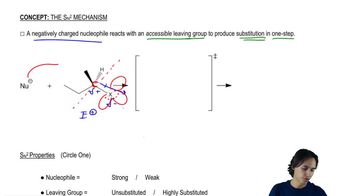
Nucleophiles and Electrophiles can react in Substitution Reactions.

SN2 Mechanism

The SN2 mechanism is a one-step process where the nucleophile attacks the electrophile from the opposite side of the leaving group, resulting in a concerted reaction. This mechanism is favored for primary alkyl halides like 1-bromohexane due to less steric hindrance, leading to the formation of hexane and sodium bromide as products.
Recommended video:
Guided course
08:33
Drawing the SN2 Mechanism

Solvent Effects on Reaction Mechanisms

The choice of solvent can significantly influence the reaction mechanism. Ethanol, being a polar protic solvent, can stabilize the transition state and the leaving group, potentially favoring the SN1 mechanism. However, in this case, the primary nature of 1-bromohexane and the strong nucleophile (sodium ethoxide) suggest that the SN2 pathway is more likely to dominate.
Recommended video:
Guided course
02:26
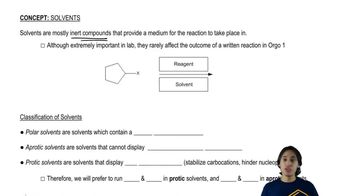
General format of reactions and how to interpret solvents.