Ch. 7 - Structure and Synthesis of Alkenes; Elimination
Wade - Organic Chemistry 9th Edition
Wade9th EditionOrganic ChemistryISBN: 9780135213728Not the one you use?Change textbook
Chapter 7, Problem 33e,f

Predict the products and mechanisms of the following reactions. When more than one product or mechanism is possible, explain which are most likely.
e. isobutyliodide + KOH in ethanol/water
f. isobutylchloride + AgNO3 in ethanol/water

Verified step by step guidance
1
Step 1: Analyze the reaction conditions for part (e) (isobutyl iodide + KOH in ethanol/water). The presence of KOH in a polar protic solvent (ethanol/water) suggests that the reaction will likely proceed via an SN2 or E2 mechanism. Consider the nucleophilicity of OH⁻ and the structure of isobutyl iodide.
Step 2: For part (e), determine the most likely mechanism. Since OH⁻ is a strong nucleophile and the substrate (isobutyl iodide) is a primary alkyl halide, the reaction is more likely to proceed via an SN2 mechanism. Write the substitution reaction where OH⁻ attacks the carbon bonded to iodine, displacing the iodide ion (I⁻).
Step 3: For part (e), consider the possibility of elimination (E2). Since the substrate is a primary alkyl halide, elimination is less favored compared to substitution. However, if the reaction conditions were more basic or involved heat, E2 could compete. Write the elimination reaction where OH⁻ abstracts a β-hydrogen, forming a double bond and releasing I⁻.
Step 4: Analyze the reaction conditions for part (f) (isobutyl chloride + AgNO₃ in ethanol/water). The presence of AgNO₃ in a polar protic solvent suggests that the reaction will likely proceed via an SN1 mechanism. Ag⁺ can coordinate with the chloride ion, facilitating its departure and forming a carbocation intermediate.
Step 5: For part (f), determine the most likely product. The carbocation formed from isobutyl chloride is a primary carbocation, which is less stable. However, the reaction may proceed slowly via SN1, leading to substitution by the solvent (ethanol/water). Write the substitution reaction where ethanol or water acts as the nucleophile, attacking the carbocation to form the corresponding ether or alcohol product.

Verified video answer for a similar problem:

This video solution was recommended by our tutors as helpful for the problem above.
Video duration:
7m
Was this helpful?

Key Concepts

Here are the essential concepts you must grasp in order to answer the question correctly.

Nucleophilic Substitution Reactions

Nucleophilic substitution reactions involve the replacement of a leaving group in a molecule by a nucleophile. The two main types are SN1 and SN2 mechanisms. SN1 is a two-step process where the leaving group departs first, forming a carbocation, followed by nucleophilic attack. SN2 is a one-step process where the nucleophile attacks the substrate simultaneously as the leaving group departs, leading to a concerted reaction.
Recommended video:
Guided course
01:47
Nucleophiles and Electrophiles can react in Substitution Reactions.

Elimination Reactions

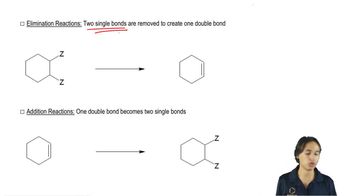
Elimination reactions involve the removal of a small molecule (like water or hydrogen halide) from a larger molecule, resulting in the formation of a double bond. The two primary types are E1 and E2 mechanisms. E1 is a two-step process similar to SN1, while E2 is a concerted mechanism where the base abstracts a proton as the leaving group departs. The choice between substitution and elimination often depends on the reaction conditions and the structure of the substrate.
Recommended video:
Guided course
00:40
Recognizing Elimination Reactions.

Solvent Effects in Organic Reactions

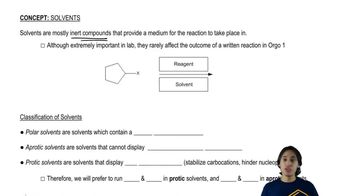
The choice of solvent can significantly influence the outcome of organic reactions. Polar protic solvents, like water and ethanol, stabilize ions and can favor SN1 and E1 mechanisms by stabilizing the carbocation intermediate. In contrast, polar aprotic solvents favor SN2 and E2 mechanisms by enhancing nucleophilicity. Understanding solvent effects is crucial for predicting reaction pathways and product distributions.
Recommended video:
Guided course
02:26
General format of reactions and how to interpret solvents.