Ch. 7 - Structure and Synthesis of Alkenes; Elimination
Wade - Organic Chemistry 9th Edition
Wade9th EditionOrganic ChemistryISBN: 9780135213728Not the one you use?Change textbook
Chapter 7, Problem 61a

Propose mechanisms for the following reactions. Additional products may be formed, but your mechanism only needs to explain the products shown.
(a)

Verified step by step guidance
1
Step 1: Identify the reaction type. The presence of CH3OH (methanol) and heat suggests a solvolysis reaction, likely involving an SN1 mechanism due to the secondary alkyl bromide substrate.
Step 2: Initiate the mechanism by forming a carbocation. The bromine atom leaves the substrate, generating a secondary carbocation at the carbon where bromine was attached. This step is the rate-determining step of the SN1 mechanism.
Step 3: Consider carbocation rearrangement. The secondary carbocation may undergo hydride or alkyl shifts to form a more stable tertiary carbocation, if possible. In this case, no rearrangement occurs as the secondary carbocation is relatively stable.
Step 4: Nucleophilic attack by methanol. Methanol (CH3OH) acts as a nucleophile and attacks the carbocation, forming the product where the methoxy group (-OCH3) is attached to the carbon that originally held the bromine.
Step 5: Elimination pathway. Under heat, the carbocation can also undergo elimination (E1 mechanism) to form alkenes. The elimination of a proton from a β-carbon leads to the formation of the two alkene products shown in the reaction.

Verified video answer for a similar problem:

This video solution was recommended by our tutors as helpful for the problem above.
Video duration:
8m
Was this helpful?

Key Concepts

Here are the essential concepts you must grasp in order to answer the question correctly.

Nucleophilic Substitution

Nucleophilic substitution is a fundamental reaction in organic chemistry where a nucleophile attacks an electrophilic carbon atom, replacing a leaving group. In this reaction, the bromine atom (Br) acts as a leaving group, and the methanol (CH3OH) can act as a nucleophile, leading to the formation of an ether product. Understanding this mechanism is crucial for predicting the products formed in the reaction.
Recommended video:
Guided course
01:47
Nucleophiles and Electrophiles can react in Substitution Reactions.

Elimination Reactions

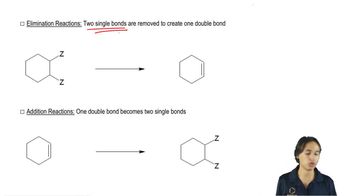
Elimination reactions involve the removal of atoms or groups from a molecule, resulting in the formation of a double bond. In the context of the provided reaction, heating can promote elimination, leading to the formation of alkenes as products. Recognizing the conditions that favor elimination versus substitution is essential for predicting the outcome of the reaction.
Recommended video:
Guided course
00:40
Recognizing Elimination Reactions.

Rearrangement Reactions

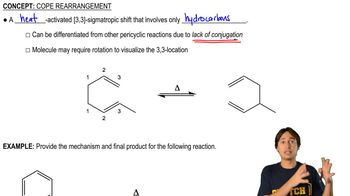
Rearrangement reactions involve the structural reorganization of a molecule, often leading to more stable isomers. In the reaction shown, the heat may facilitate the rearrangement of the initial product to yield different structural isomers. Understanding how and why molecules rearrange is important for predicting the variety of products that can form in complex organic reactions.
Recommended video:
Guided course
06:28
Definition of Cope Rearrangement
Related Practice
Textbook Question

Silver-assisted solvolysis of bromomethylcyclopentane in methanol gives a complex product mixture of the following five compounds. Propose mechanisms to account for these products.

(a)

857
views

Textbook Question

Propose mechanisms for the following reactions. Additional products may be formed, but your mechanism only needs to explain the products shown.

(b)

637
views
Textbook Question

Show how you would convert (in one or two steps) 1-phenylpropane to the three products shown below. In each case, explain what unwanted reactions might produce undesirable impurities in the product.

1191
views
Textbook Question

E1 eliminations of alkyl halides are rarely useful for synthetic purposes because they give mixtures of substitution and elimination products. Explain why the sulfuric acid-catalyzed dehydration of cyclohexanol gives a good yield of cyclohexene even though the reaction goes by an E1 mechanism. (Hint: What are the nucleophiles in the reaction mixture? What products are formed if these nucleophiles attack the carbocation? What further reactions can these substitution products undergo?)

1614
views
Textbook Question

Show how you would convert (in one or two steps) 1-phenylpropane to the three products shown below. In each case, explain what unwanted reactions might produce undesirable impurities in the product.

831
views
Textbook Question

Propose mechanisms for the following reactions. Additional products may be formed, but your mechanism only needs to explain the products shown.

(c)

656
views