Ch. 7 - Structure and Synthesis of Alkenes; Elimination
Wade - Organic Chemistry 9th Edition
Wade9th EditionOrganic ChemistryISBN: 9780135213728Not the one you use?Change textbook
Chapter 7, Problem 58b

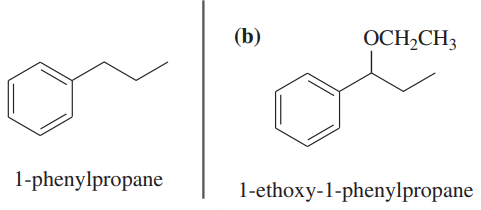
Show how you would convert (in one or two steps) 1-phenylpropane to the three products shown below. In each case, explain what unwanted reactions might produce undesirable impurities in the product.
Chemical structures of 1-phenylpropane and 1-ethoxy-1-phenylpropane with labels indicating each compound.

Verified step by step guidance
1
Step 1: Analyze the starting material, 1-phenylpropane, and identify the functional groups present. It contains a benzene ring and a propane chain. The target product, 1-ethoxy-1-phenylpropane, requires the introduction of an ethoxy group (-OCH2CH3) at the first carbon of the propane chain.
Step 2: To achieve this transformation, perform an electrophilic substitution reaction at the benzylic position (the carbon adjacent to the benzene ring). First, oxidize the benzylic carbon to form a benzylic carbocation intermediate. This can be achieved using a reagent like Br2 or Cl2 in the presence of light or heat to form a benzylic halide.
Step 3: Once the benzylic halide is formed, perform a nucleophilic substitution reaction (SN2 mechanism) using sodium ethoxide (NaOCH2CH3) as the nucleophile. This will replace the halide group with the ethoxy group, yielding 1-ethoxy-1-phenylpropane.
Step 4: Consider potential side reactions that could lead to impurities. For example, over-oxidation of the benzylic position could lead to the formation of benzoic acid derivatives. Additionally, competing elimination reactions during the nucleophilic substitution step could produce alkenes instead of the desired product.
Step 5: To minimize impurities, carefully control reaction conditions such as temperature, reagent concentration, and reaction time. Use excess sodium ethoxide to favor substitution over elimination and avoid over-oxidation by monitoring the reaction closely.

Verified video answer for a similar problem:

This video solution was recommended by our tutors as helpful for the problem above.
Video duration:
4m
Was this helpful?

Key Concepts

Here are the essential concepts you must grasp in order to answer the question correctly.

Nucleophilic Substitution

Nucleophilic substitution is a fundamental reaction in organic chemistry where a nucleophile attacks an electrophile, replacing a leaving group. In the context of converting 1-phenylpropane to 1-ethoxy-1-phenylpropane, an ethoxide ion can act as the nucleophile, attacking the carbon atom bonded to the leaving group. Understanding this mechanism is crucial for predicting the products and potential side reactions.
Recommended video:
Guided course
01:47
Nucleophiles and Electrophiles can react in Substitution Reactions.

Rearrangement Reactions

Rearrangement reactions involve the structural reorganization of a molecule, often leading to the formation of more stable products. In the conversion of 1-phenylpropane, if conditions favor rearrangement, undesired products may form, such as isomers or byproducts that could complicate purification. Recognizing the possibility of rearrangements helps in designing reactions to minimize impurities.
Recommended video:
Guided course
06:28
Definition of Cope Rearrangement

Side Reactions and Impurities

Side reactions are unintended reactions that can occur alongside the desired reaction, leading to impurities in the final product. In the case of converting 1-phenylpropane, potential side reactions could include elimination or polymerization, which may produce undesired byproducts. Awareness of these side reactions is essential for optimizing reaction conditions and improving product yield and purity.
Recommended video:
2:36
Side-Chain Reactions of Substituted Pyridines Concept 1