Ch. 7 - Structure and Synthesis of Alkenes; Elimination
Wade - Organic Chemistry 9th Edition
Wade9th EditionOrganic ChemistryISBN: 9780135213728Not the one you use?Change textbook
Chapter 7, Problem 58c

Show how you would convert (in one or two steps) 1-phenylpropane to the three products shown below. In each case, explain what unwanted reactions might produce undesirable impurities in the product.
Chemical structures of 1-phenylpropane and 1-phenylprop-1-ene with labels indicating each compound.

Verified step by step guidance
1
Step 1: To convert 1-phenylpropane to 1-phenylprop-1-ene, perform a dehydrogenation reaction. This can be achieved using a strong base such as potassium tert-butoxide (KOtBu) in the presence of heat. The base abstracts a proton from the β-carbon, leading to the formation of the double bond between the α and β carbons.
Step 2: Consider potential side reactions. Unwanted reactions might include over-dehydrogenation, leading to the formation of conjugated dienes or other byproducts. To minimize these, control the reaction conditions carefully, such as temperature and base concentration.
Step 3: Analyze the stereochemistry of the product. The reaction may produce both E and Z isomers of 1-phenylprop-1-ene. Separation or purification techniques, such as distillation or chromatography, may be required to isolate the desired isomer.
Step 4: Ensure the reaction is selective for the desired product. Using sterically hindered bases like KOtBu can help favor the formation of the desired alkene while minimizing side reactions.
Step 5: Confirm the product structure using spectroscopic techniques such as NMR or IR spectroscopy to ensure the formation of 1-phenylprop-1-ene and check for impurities.

Verified video answer for a similar problem:

This video solution was recommended by our tutors as helpful for the problem above.
Video duration:
3m
Was this helpful?

Key Concepts

Here are the essential concepts you must grasp in order to answer the question correctly.

Alkene Formation

Alkene formation involves the elimination of a small molecule, typically water or hydrogen halide, from an alkane or alcohol, resulting in a double bond. In the case of converting 1-phenylpropane to 1-phenylprop-1-ene, a dehydration or dehydrohalogenation reaction can be employed. Understanding the conditions and reagents that favor this transformation is crucial for achieving the desired product.
Recommended video:
2:09
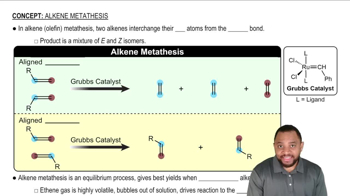
Alkene Metathesis Concept 1

Rearrangement Reactions

Rearrangement reactions occur when the structure of a molecule changes to form a more stable isomer. In organic synthesis, these reactions can lead to unwanted products if the reaction conditions favor rearrangement over the desired pathway. Recognizing potential rearrangements is essential to minimize impurities and ensure the selectivity of the reaction.
Recommended video:
Guided course
06:28
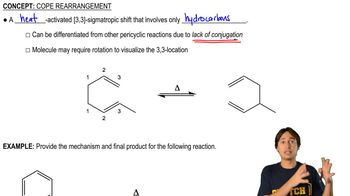
Definition of Cope Rearrangement

Side Reactions and Impurities

Side reactions are unintended reactions that can occur alongside the desired reaction, leading to the formation of impurities. These can arise from various factors, including the presence of reactive intermediates or inappropriate reaction conditions. Identifying and controlling these side reactions is vital for purifying the final product and achieving high yields of the desired compound.
Recommended video:
2:36
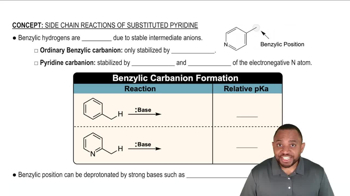
Side-Chain Reactions of Substituted Pyridines Concept 1