
Textbook Question
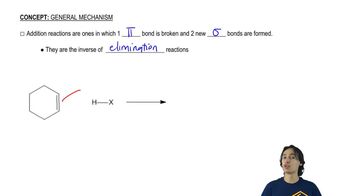
Propose mechanisms consistent with the following reactions.
(g)
1496
views

 Verified step by step guidance
 05:39
05:39
 3:39
3:39 1:38
1:38Propose mechanisms consistent with the following reactions.
(g)
Propose mechanisms consistent with the following reactions.
(f)
Draw an approximate reaction-energy diagram showing the curves for the two possible pathways for ionic addition of HBr to 1-methylcyclohexene. (a) Formation of the major product, 1-bromo-1-methylcyclohexane, and (b) formation of the minor product, 1-bromo-2-methylcyclohexane. Point out how these curves show that 1-bromo-1-methylcyclohexane should be formed faster.
One of the constituents of turpentine is α-pinene, formula C10H6. The following scheme (called a “road map”) gives some reactions of α-pinene. Determine the structure of α-pinene and of the reaction products of A through E.
The sex attractant of the housefly has the formula C23H46. When treated with warm potassium permanganate, this pheromone gives two products: CH3(CH2)12COOH and CH3(CH2)7COOH. Suggest a structure for this sex attractant. Explain which part of the structure is uncertain.
Unknown X, C5H9Br does not react with bromine or with dilute KMnO4. Upon treatment with potassium tert-butoxide, X gives only one product, Y, C5H8. Unlike X, Y decolorizes bromine and changes KMnO4 from purple to brown. Catalytic hydrogenation of Y gives methylcyclobutane. Ozonolysis–reduction of Y gives dialdehyde Z, C5H8O2. Propose consistent structures for X, Y, and Z. Is there any aspect of the structure of X that is still unknown?