Ch.8 - Reactions of Alkenes
Wade - Organic Chemistry 9th Edition
Wade9th EditionOrganic ChemistryISBN: 9780135213728Not the one you use?Change textbook
Chapter 8, Problem 56f

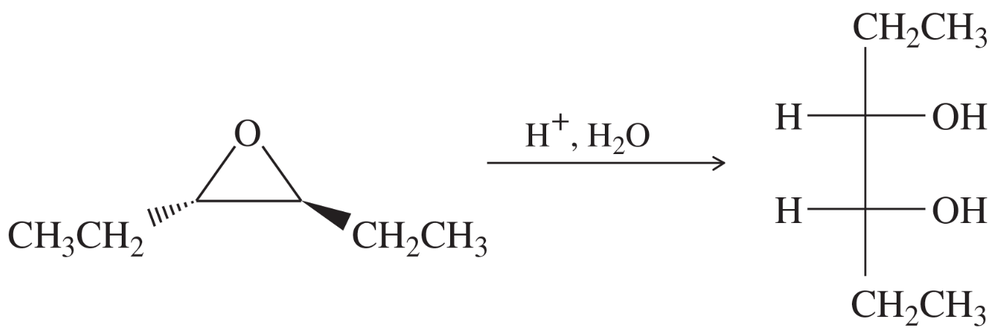
Propose mechanisms consistent with the following reactions.
(f)

Verified step by step guidance
1
Step 1: Recognize that the starting material is an epoxide, which is a three-membered cyclic ether. Epoxides are highly strained and reactive, especially under acidic conditions.
Step 2: Under acidic conditions (H⁺, H₂O), the epoxide undergoes ring-opening. The proton (H⁺) first protonates the oxygen atom in the epoxide, increasing its electrophilicity and making the ring more susceptible to nucleophilic attack.
Step 3: Water (H₂O) acts as the nucleophile and attacks one of the carbon atoms in the epoxide ring. The attack occurs at the more substituted carbon atom due to the stability of the resulting carbocation-like transition state.
Step 4: The ring opens, and the nucleophile (water) adds to the carbon atom. This results in the formation of a diol (a molecule with two hydroxyl groups). The stereochemistry of the product is determined by the anti-addition mechanism, where the hydroxyl groups are added on opposite sides of the original epoxide ring.
Step 5: The final product is a vicinal diol (1,2-diol) with hydroxyl groups on adjacent carbons. The stereochemistry of the product reflects the anti-addition mechanism, with the hydroxyl groups being trans to each other.

Verified video answer for a similar problem:

This video solution was recommended by our tutors as helpful for the problem above.
Video duration:
9m
Was this helpful?

Key Concepts

Here are the essential concepts you must grasp in order to answer the question correctly.

Epoxide Ring Opening

Epoxides are three-membered cyclic ethers that are highly reactive due to the strain in their ring structure. The opening of an epoxide ring typically occurs under acidic or basic conditions, where nucleophiles attack the less hindered carbon atom. In this reaction, the epoxide shown is opened by water in the presence of an acid, leading to the formation of diols.
Recommended video:
Guided course
04:34
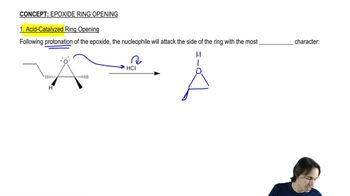
Acid-Catalyzed Epoxide Ring-Opening

Acid-Catalyzed Hydration

Acid-catalyzed hydration involves the addition of water to a double bond or a reactive group in the presence of an acid. The acid protonates the oxygen in the epoxide, making it more electrophilic, which facilitates the nucleophilic attack by water. This process results in the formation of alcohols, as seen in the product of the reaction.
Recommended video:
Guided course
06:34
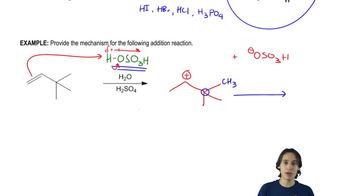
Acid-catalyzed hydration mechanism

Stereochemistry of Products

The stereochemistry of the products formed from the epoxide opening is crucial for understanding the reaction's outcome. The attack of the nucleophile can lead to the formation of stereocenters, and the configuration of these centers will depend on the mechanism of the reaction. In this case, the product shows two alcohol groups, which can exhibit different stereochemical arrangements based on the regioselectivity of the nucleophilic attack.
Recommended video:
1:38
Polymer Stereochemistry Concept 1