Ch.8 - Reactions of Alkenes
Wade - Organic Chemistry 9th Edition
Wade9th EditionOrganic ChemistryISBN: 9780135213728Not the one you use?Change textbook
Chapter 8, Problem 57

Draw an approximate reaction-energy diagram showing the curves for the two possible pathways for ionic addition of HBr to 1-methylcyclohexene. (a) Formation of the major product, 1-bromo-1-methylcyclohexane, and (b) formation of the minor product, 1-bromo-2-methylcyclohexane. Point out how these curves show that 1-bromo-1-methylcyclohexane should be formed faster.

Verified step by step guidance
1
Step 1: Begin by understanding the reaction mechanism for the ionic addition of HBr to 1-methylcyclohexene. This involves the electrophilic attack of HBr on the double bond of 1-methylcyclohexene, leading to the formation of a carbocation intermediate.
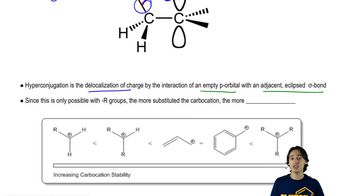
Step 2: Identify the two possible carbocation intermediates that can form. The major pathway leads to the formation of a tertiary carbocation (more stable due to hyperconjugation and inductive effects), while the minor pathway leads to a secondary carbocation (less stable). Stability of the carbocation is key to determining the major product.
Step 3: Draw the reaction-energy diagram for both pathways. On the x-axis, represent the reaction progress, and on the y-axis, represent the energy. The curve for the major pathway (leading to 1-bromo-1-methylcyclohexane) should show a lower energy transition state and intermediate compared to the minor pathway (leading to 1-bromo-2-methylcyclohexane).
Step 4: Label the energy diagram clearly. Indicate the energy of the reactants, the transition states for both pathways, and the energy of the products. The major product (1-bromo-1-methylcyclohexane) will have a lower activation energy, showing that it is formed faster, while the minor product (1-bromo-2-methylcyclohexane) will have a higher activation energy.
Step 5: Highlight the key takeaway from the diagram: The lower activation energy for the major pathway explains why 1-bromo-1-methylcyclohexane is formed faster and is the major product. The stability of the tertiary carbocation intermediate plays a crucial role in determining the reaction pathway.

Verified video answer for a similar problem:

This video solution was recommended by our tutors as helpful for the problem above.
Video duration:
8m
Was this helpful?

Key Concepts

Here are the essential concepts you must grasp in order to answer the question correctly.

Reaction Energy Diagram

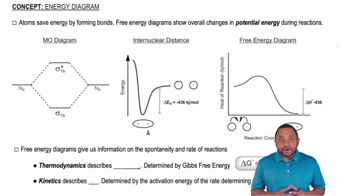
A reaction energy diagram visually represents the energy changes during a chemical reaction. It typically shows the energy of reactants, products, and the transition states along the reaction coordinate. The height of the energy barriers indicates the activation energy required for the reaction to proceed, which helps in understanding the kinetics and thermodynamics of the reaction pathways.
Recommended video:
Guided course
06:07
Introduction to free energy diagrams.

Ionic Addition Mechanism

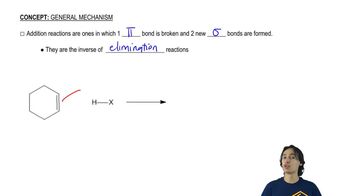
The ionic addition mechanism involves the stepwise addition of electrophiles and nucleophiles to alkenes. In the case of HBr addition to 1-methylcyclohexene, the first step is the formation of a carbocation intermediate, which can lead to different products depending on the stability of the carbocation formed. The stability of these intermediates influences the rate of formation of the major and minor products.
Recommended video:
Guided course
05:39
Features of Addition Mechanisms.

Product Stability and Kinetics

The stability of the products and intermediates plays a crucial role in determining the reaction pathway and the rate of product formation. In this case, 1-bromo-1-methylcyclohexane is formed from a more stable carbocation compared to 1-bromo-2-methylcyclohexane. The lower activation energy for the pathway leading to the major product indicates that it will be formed faster, as shown in the reaction energy diagram.
Recommended video:
Guided course
05:58
Determining Carbocation Stability