

When 1-chlorocyclohexene reacts with HBr, the major product is 1-bromo-1-chlorocyclohexane. Propose a mechanism for this reaction, and explain why your proposed intermediate is more stable than the other possible intermediate
Ch.8 - Reactions of Alkenes
Chapter 8, Problem 3b
Predict the major products of the following reactions, and propose mechanisms to support your predictions.
(b) 
HINT: Remember to write out complete structures, including all bonds and charges, when writing a mechanism or determining the course of a reaction.
Verified step by step guidance1
Step 1: Recognize the reaction conditions. The presence of HBr and di-tert-butyl peroxide indicates that this is a free radical addition reaction. Di-tert-butyl peroxide serves as a radical initiator, which promotes anti-Markovnikov addition of HBr to the alkene.
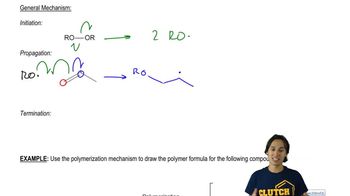
Step 2: Initiation step: Di-tert-butyl peroxide decomposes under heat to form two tert-butoxy radicals. This decomposition is represented as: (CH₃)₃COOC(CH₃)₃ → 2(CH₃)₃CO•.
Step 3: Propagation step 1: The tert-butoxy radical abstracts a hydrogen atom from HBr, generating a bromine radical (Br•). This step is represented as: (CH₃)₃CO• + HBr → (CH₃)₃COH + Br•.
Step 4: Propagation step 2: The bromine radical reacts with 1-phenylpropene, attacking the less substituted carbon of the double bond (anti-Markovnikov addition). This forms a new carbon radical at the more substituted carbon. The intermediate radical is stabilized by resonance with the phenyl group.
Step 5: Termination step: The carbon radical formed in the previous step reacts with another HBr molecule, abstracting a hydrogen atom to form the final product. The major product is 1-bromo-2-phenylpropane, resulting from anti-Markovnikov addition.

Verified video answer for a similar problem:
This video solution was recommended by our tutors as helpful for the problem above.
Video duration:
8mWas this helpful?
Key Concepts
Here are the essential concepts you must grasp in order to answer the question correctly.
Electrophilic Addition Reactions
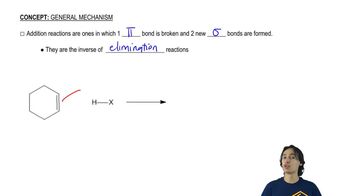
Electrophilic addition reactions involve the addition of an electrophile to a nucleophile, typically across a double bond. In the case of alkenes, such as 1-phenylpropene, the π bond acts as a nucleophile, reacting with electrophiles like HBr. Understanding this mechanism is crucial for predicting the products formed during the reaction.
Recommended video:
Guided course
Features of Addition Mechanisms.
Radical Mechanisms
Radical mechanisms involve the formation of free radicals, which are highly reactive species with unpaired electrons. The presence of di-tert-butyl peroxide in the reaction suggests a radical pathway, where the peroxide decomposes to generate radicals that can initiate the addition of HBr to the alkene. Recognizing this mechanism is essential for predicting the major products.
Recommended video:
Guided course
The mechanism of Radical Polymerization.
Markovnikov's Rule
Markovnikov's Rule states that in the addition of HX to an alkene, the hydrogen atom will attach to the carbon with the greater number of hydrogen atoms already attached. This rule helps predict the regioselectivity of the reaction products, particularly in the case of asymmetric alkenes like 1-phenylpropene, guiding the formation of the more stable carbocation intermediate.
Recommended video:
Guided course
The 18 and 16 Electron Rule
Related Practice
Textbook Question
1389
views
Textbook Question
Predict the major products of the following reactions, and propose mechanisms to support your predictions.
b. 2-methylpropene + HCl
1594
views
Textbook Question
When 1 mole of buta-1,3-diene reacts with 1 mole of HBr, both 3-bromobut-1-ene and 1-bromobut-2-ene are formed. Propose a mechanism to account for this mixture of products.
1927
views
Textbook Question
Show how you would accomplish the following synthetic conversions.
(a) but−1−ene → 1−bromobutane
(b) but−1−ene → 2−bromobutane
1406
views
Textbook Question
Show how you would accomplish the following synthetic conversions.
(c) 2−methylcyclohexanol → 1−bromo−1−methylcyclohexane
911
views
Textbook Question
Show how you would accomplish the following synthetic conversions.
(d) 2−methylbutan-2-ol → 2-bromo-3-methylbutane
1098
views
