

Ch.8 - Reactions of Alkenes
Wade - Organic Chemistry 9th Edition
Wade9th EditionOrganic ChemistryISBN: 9780135213728Not the one you use?Change textbook
Chapter 8, Problem 4c

Show how you would accomplish the following synthetic conversions.
(c) 2−methylcyclohexanol → 1−bromo−1−methylcyclohexane

Verified step by step guidance
1
Identify the functional group transformation: The starting material is 2-methylcyclohexanol (an alcohol), and the target compound is 1-bromo-1-methylcyclohexane (an alkyl halide). This indicates that the hydroxyl group (-OH) must be replaced with a bromine atom (Br).
Protonate the hydroxyl group to make it a better leaving group: Treat 2-methylcyclohexanol with a strong acid, such as HBr. The hydroxyl group will be protonated to form water (H₂O), which is a good leaving group.
Perform a carbocation rearrangement: When the water molecule leaves, a carbocation intermediate is formed. The initial carbocation will be at the 2-position, but a hydride shift will occur to form a more stable tertiary carbocation at the 1-position.
Introduce the bromine nucleophile: The bromide ion (Br⁻) from HBr will attack the carbocation at the 1-position, resulting in the formation of 1-bromo-1-methylcyclohexane.
Verify the stereochemistry: Since the reaction proceeds through a carbocation intermediate, the product will likely be a racemic mixture if the starting material is chiral. Ensure that the final product matches the desired structure.

Verified video answer for a similar problem:

This video solution was recommended by our tutors as helpful for the problem above.
Video duration:
3m
Was this helpful?

Key Concepts

Here are the essential concepts you must grasp in order to answer the question correctly.

Alcohol to Alkyl Halide Conversion

The conversion of alcohols to alkyl halides is typically achieved through a substitution reaction, where the hydroxyl group (-OH) of the alcohol is replaced by a halogen atom. This can be accomplished using reagents such as phosphorus tribromide (PBr3) or thionyl chloride (SOCl2), which facilitate the departure of the -OH group and introduce the halide.
Recommended video:
Guided course
01:52
How to name alkyl halides

Rearrangement and Stability of Carbocations

In organic synthesis, the stability of carbocations plays a crucial role in determining the pathway of a reaction. When converting 2-methylcyclohexanol to 1-bromo-1-methylcyclohexane, the formation of a stable tertiary carbocation can be favored, which may involve rearrangement of the molecule to achieve a more stable intermediate before the final product is formed.
Recommended video:
Guided course
05:58
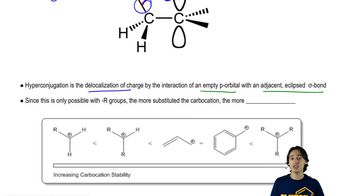
Determining Carbocation Stability

Stereochemistry in Substitution Reactions

Stereochemistry is essential in substitution reactions, as the configuration of the starting material can influence the outcome of the reaction. In the case of 2-methylcyclohexanol, understanding the stereochemical arrangement of the reactant will help predict the stereochemical outcome of the product, particularly if the reaction proceeds via an SN1 or SN2 mechanism.
Recommended video:
1:38
Polymer Stereochemistry Concept 1