
Ch.8 - Reactions of Alkenes
Wade - Organic Chemistry 9th Edition
Wade9th EditionOrganic ChemistryISBN: 9780135213728Not the one you use?Change textbook
Chapter 8, Problem 4a,b

Show how you would accomplish the following synthetic conversions.
(a) but−1−ene → 1−bromobutane
(b) but−1−ene → 2−bromobutane

Verified step by step guidance
1
Step 1: For part (a), recognize that the conversion of but-1-ene to 1-bromobutane involves an anti-Markovnikov addition of HBr. This can be achieved using the hydrohalogenation reaction in the presence of peroxides (ROOR). The peroxides initiate a radical mechanism that ensures the bromine atom adds to the less substituted carbon of the double bond, resulting in 1-bromobutane.
Step 2: Write the reaction mechanism for part (a). The mechanism involves three steps: (1) initiation, where the peroxide decomposes to form radicals; (2) propagation, where the radical reacts with HBr to form a bromine radical, which then reacts with but-1-ene to form a new radical intermediate; and (3) termination, where radicals combine to form the final product, 1-bromobutane.
Step 3: For part (b), recognize that the conversion of but-1-ene to 2-bromobutane involves a Markovnikov addition of HBr. This can be achieved using hydrohalogenation without peroxides. In this case, the hydrogen atom adds to the less substituted carbon of the double bond, and the bromine atom adds to the more substituted carbon, resulting in 2-bromobutane.
Step 4: Write the reaction mechanism for part (b). The mechanism involves the formation of a carbocation intermediate. The double bond in but-1-ene attacks the hydrogen atom of HBr, forming a carbocation on the more stable secondary carbon. The bromide ion then attacks the carbocation, resulting in 2-bromobutane.
Step 5: Summarize the key difference between the two reactions. The presence of peroxides in part (a) leads to an anti-Markovnikov product (1-bromobutane), while the absence of peroxides in part (b) leads to a Markovnikov product (2-bromobutane). Ensure to draw the reaction schemes for both conversions to visualize the transformations.

Verified video answer for a similar problem:

This video solution was recommended by our tutors as helpful for the problem above.
Video duration:
4m
Was this helpful?

Key Concepts

Here are the essential concepts you must grasp in order to answer the question correctly.

Electrophilic Addition Reactions

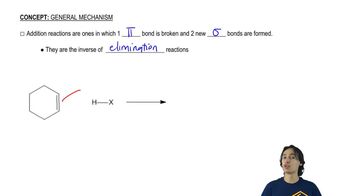
Electrophilic addition reactions are a fundamental type of reaction in organic chemistry where an electrophile reacts with a nucleophile, typically involving alkenes. In the case of but-1-ene, the double bond acts as a nucleophile, allowing for the addition of bromine or bromide ions to form bromoalkanes. Understanding this mechanism is crucial for predicting the products of the conversions.
Recommended video:
Guided course
05:39
Features of Addition Mechanisms.

Regioselectivity

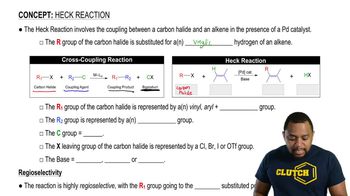
Regioselectivity refers to the preference of a chemical reaction to yield one structural isomer over others when multiple possibilities exist. In the conversion of but-1-ene to 2-bromobutane, the addition of bromine can occur at different positions, but the more stable secondary carbocation is favored, leading to the formation of the more substituted product. Recognizing regioselectivity helps in determining the major product in synthetic pathways.
Recommended video:
Guided course
05:09
Heck Reaction

Carbocation Stability

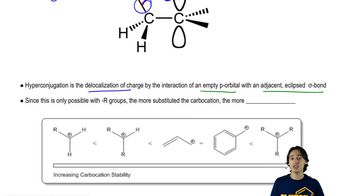
Carbocation stability is a key concept in organic chemistry that influences reaction pathways and product formation. Carbocations are positively charged species that can form during electrophilic addition reactions. The stability of a carbocation increases with the degree of substitution; tertiary carbocations are more stable than secondary, which in turn are more stable than primary. This stability plays a critical role in determining the outcome of the synthetic conversions in the question.
Recommended video:
Guided course
05:58
Determining Carbocation Stability