Ch.8 - Reactions of Alkenes
Wade - Organic Chemistry 9th Edition
Wade9th EditionOrganic ChemistryISBN: 9780135213728Not the one you use?Change textbook
Chapter 8, Problem 56d

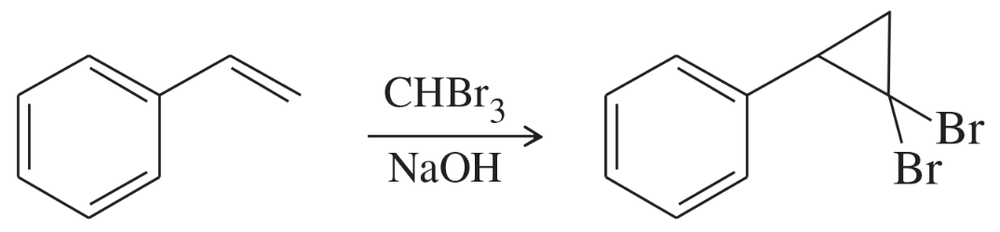
Propose mechanisms consistent with the following reactions.
(d)

Verified step by step guidance
1
Step 1: Recognize the reaction type. This reaction involves the formation of a dibromo-substituted cyclopropane ring from an alkene. The reagents CHBr₃ (bromoform) and NaOH suggest a haloform reaction followed by cyclopropanation.
Step 2: Understand the role of the reagents. NaOH deprotonates CHBr₃ to form the tribromomethyl anion (CBr₃⁻), which is highly nucleophilic and reactive. This intermediate is key to the reaction mechanism.
Step 3: Analyze the alkene's role. The alkene acts as a nucleophile and reacts with the tribromomethyl anion. The π-electrons of the alkene attack the electrophilic carbon of the tribromomethyl group, forming a new bond.
Step 4: Formation of the cyclopropane ring. After the initial attack, two bromine atoms are eliminated from the tribromomethyl group, resulting in the formation of a cyclopropane ring with two bromine substituents attached to the same carbon.
Step 5: Verify the product structure. The final product is a dibromo-substituted cyclopropane ring attached to the benzene ring. This structure is consistent with the reaction mechanism and the given reagents.

Verified video answer for a similar problem:

This video solution was recommended by our tutors as helpful for the problem above.
Video duration:
2m
Was this helpful?

Key Concepts

Here are the essential concepts you must grasp in order to answer the question correctly.

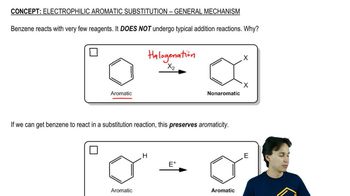
Electrophilic Aromatic Substitution

Electrophilic aromatic substitution (EAS) is a fundamental reaction in organic chemistry where an electrophile replaces a hydrogen atom on an aromatic ring. In this mechanism, the aromatic system donates electrons to the electrophile, forming a sigma complex, which then loses a proton to restore aromaticity. Understanding EAS is crucial for analyzing reactions involving aromatic compounds, such as the one depicted in the question.
Recommended video:

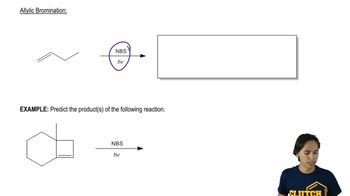
Bromination Mechanism

The bromination mechanism involves the introduction of bromine into an organic compound, typically through the use of brominating agents like CHBr3. In the presence of a base like NaOH, the bromine can be activated to form a more reactive species that can effectively substitute hydrogen atoms on the aromatic ring. This mechanism is essential for understanding how the brominated product is formed in the given reaction.
Recommended video:
Guided course
00:54
Mechanism of Allylic Bromination.

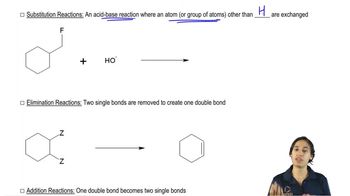
Regioselectivity in Substitution Reactions

Regioselectivity refers to the preference of a chemical reaction to yield one structural isomer over others when multiple possibilities exist. In the context of electrophilic aromatic substitution, the position where the electrophile attaches to the aromatic ring can be influenced by existing substituents. Recognizing the regioselectivity in the reaction shown helps predict the final structure of the brominated product.
Recommended video:
Guided course
01:34
Recognizing Substitution Reactions.