
Ch.6 - Alkyl Halides; Nucleophilic Substitution
Wade - Organic Chemistry 9th Edition
Wade9th EditionOrganic ChemistryISBN: 9780135213728Not the one you use?Change textbook
Chapter 6, Problem 52

Because the SN1 reaction goes through a flat carbocation, we might expect an optically active starting material to give a completely racemized product. In most cases, however, SN1 reactions actually give more of the inversion product. In general, as the stability of the carbocation increases, the excess inversion product decreases. Extremely stable carbocations give completely racemic products. Explain these observations.

Verified step by step guidance
1
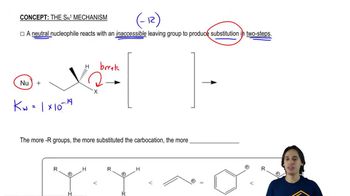
The SN1 reaction mechanism involves the formation of a carbocation intermediate. This intermediate is planar and sp2 hybridized, meaning it is flat and can be attacked by a nucleophile from either side. This is why we might expect a racemic mixture of products.
However, in most cases, the nucleophile does not have equal access to both sides of the carbocation. The leaving group, which departs during the first step of the SN1 reaction, often remains close to the carbocation and partially blocks one side, favoring nucleophilic attack from the opposite side. This results in more of the inversion product.
The stability of the carbocation plays a key role in determining the degree of inversion versus racemization. As the stability of the carbocation increases (e.g., tertiary carbocations or resonance-stabilized carbocations), the leaving group is less likely to remain close to the carbocation, allowing the nucleophile to attack from either side more equally. This leads to a more racemic product.
Extremely stable carbocations, such as those stabilized by extensive resonance or hyperconjugation, allow the leaving group to completely dissociate and move far away from the carbocation. In these cases, the nucleophile has equal access to both sides of the planar carbocation, resulting in a completely racemic product.
In summary, the degree of inversion versus racemization in SN1 reactions is influenced by the steric hindrance caused by the leaving group and the stability of the carbocation. Less stable carbocations favor inversion due to steric blocking by the leaving group, while highly stable carbocations favor racemization due to equal access for the nucleophile.

Verified video answer for a similar problem:

This video solution was recommended by our tutors as helpful for the problem above.
Video duration:
6m
Was this helpful?

Key Concepts

Here are the essential concepts you must grasp in order to answer the question correctly.

SN1 Reaction Mechanism

The SN1 (substitution nucleophilic unimolecular) reaction involves a two-step mechanism where the first step is the formation of a carbocation intermediate after the leaving group departs. This carbocation is planar and can be attacked by the nucleophile from either side, leading to the potential for racemization. However, the stability of the carbocation significantly influences the reaction pathway and product distribution.
Recommended video:
Guided course
10:49
Drawing the SN1 Mechanism

Carbocation Stability

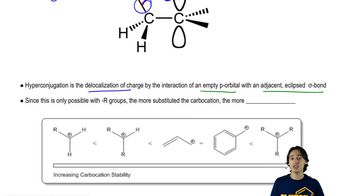
Carbocations are positively charged species that can vary in stability based on their structure. Tertiary carbocations are more stable than secondary or primary ones due to hyperconjugation and inductive effects from surrounding alkyl groups. The stability of the carbocation affects the likelihood of inversion versus retention of configuration during nucleophilic attack, with more stable carbocations tending to lead to racemic mixtures.
Recommended video:
Guided course
05:58
Determining Carbocation Stability

Inversion vs. Retention in SN1 Reactions

In SN1 reactions, the nucleophile can attack the planar carbocation from either side, leading to two possible outcomes: inversion of configuration (where the product has the opposite stereochemistry of the starting material) or retention (where the product retains the original stereochemistry). The ratio of these products can be influenced by the stability of the carbocation; less stable carbocations tend to favor inversion, while more stable ones can lead to a racemic mixture due to equal likelihood of attack from both sides.
Recommended video:
Guided course
08:16
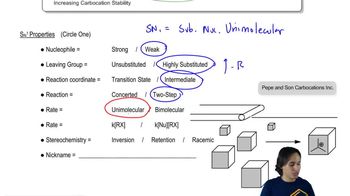
Understanding the properties of SN1.
Related Practice
Textbook Question

Triethyloxonium tetrafluoroborate, (CH3CH2)3O+ BF4, is a solid with melting point 91–92°C. Show how this reagent can transfer an ethyl group to a nucleophile (Nuc:) in an SN2 reaction. What is the leaving group? Why might this reagent be preferred to using an ethyl halide? (Consult Table 6-2)

1209
views
Textbook Question

Give a mechanism to explain the two products formed in the following reaction.

1084
views
Textbook Question

Using 1,2-dimethylcyclohexene as your starting material, show how you would synthesize the following compounds. (Once you have shown how to synthesize a compound, you may use it as the starting material in any later parts of this problem.) If a chiral product is shown, assume that it is part of a racemic mixture.

(f)

181
views
Textbook Question

The following reaction takes place under second-order conditions (strong nucleophile), yet the structure of the product shows rearrangement. Also, the rate of this reaction is several thousand times faster than the rate of substitution of ­hydroxide ion on 2-chlorobutane under similar conditions. Propose a mechanism to explain the enhanced rate and ­rearrangement observed in this unusual reaction. (“Et” is the abbreviation for ethyl.)

659
views
Textbook Question

Optically active butan-2-ol racemizes in dilute acid. Propose a mechanism for this racemization.

1333
views
Textbook Question

Furfuryl chloride can undergo substitution by both SN2 and SN1 mechanisms. Because it is a 1° alkyl halide, we expect SN2 but not SN1 reactions. Draw a mechanism for the SN1 reaction shown below, paying careful attention to the structure of the intermediate. How can this primary halide undergo SN1 reactions?

1793
views
1
rank