Back
Back
Problem 5.3.94a
Working with area functions Consider the function ƒ and the points a, b, and c.
(a) Find the area function A (𝓍) = ∫ₐˣ ƒ(t) dt using the Fundamental Theorem.
ƒ(𝓍) = sin 𝓍 ; a = 0 , b = π/2 , c = π
Problem 5.4.4a
Suppose ƒ is an odd function, ∫₀⁴ ƒ(𝓍) d𝓍 = 3 , and ∫₀⁸ ƒ(𝓍) d𝓍 = 9 .
(a) Evaluate ∫₋₈⁴ ƒ(𝓍) d𝓍 .
Problem 5.4.45a
Explain why or why not Determine whether the following statements are true and give an explanation or counterexample.
(a) If ƒ is symmetric about the line 𝓍 = 2 , then ∫₀⁴ ƒ(𝓍) d𝓍 = 2 ∫₀² ƒ(𝓍) d𝓍.
Problem 5.3.13a
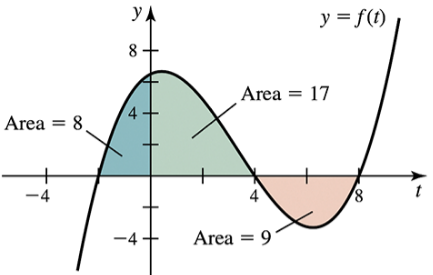
Area functions The graph of ƒ is shown in the figure. Let A(x) = ∫₋₂ˣ ƒ(t) dt and F(x) = ∫₄ˣ ƒ(t) dt be two area functions for ƒ. Evaluate the following area functions.
(a) A (―2)
Problem 5.1.15a
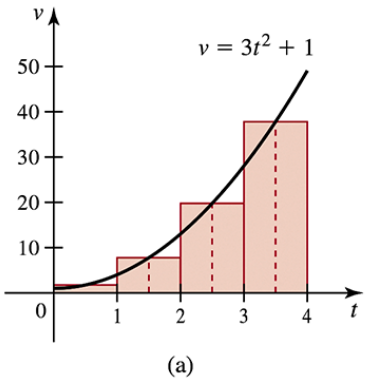
Approximating displacement The velocity in ft/s of an object moving along a line is given by v = 3t² + 1 on the interval 0 ≤ t ≤ 4, where t is measured in seconds.
(a) Divide the interval [0,4] into n = 4 subintervals, [0,1] , [1.2] , [2,3] , and [3,4]. On each subinterval, assume the object moves at a constant velocity equal to v evaluated at the midpoint of the subinterval, and use these approximations to estimate the displacement of the object on [0, 4] (see part (a) of the figure)
Problem 5.2.75a
{Use of Tech} Midpoint Riemann sums with a calculator Consider the following definite integrals.
(a) Write the midpoint Riemann sum in sigma notation for an arbitrary value of n.
∫₁⁴ 2√𝓍 d𝓍
Problem 5.1.69a
Approximating areas Estimate the area of the region bounded by the graph of ƒ(𝓍) = x² + 2 and the x-axis on [0, 2] in the following ways.
(a) Divide [0, 2] into n = 4 subintervals and approximate the area of the region using a left Riemann sum. Illustrate the solution geometrically.
Problem 5.3.22a
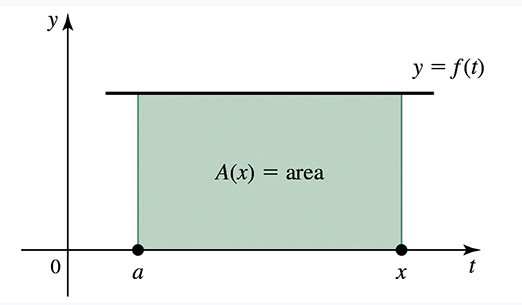
Area functions for linear functions Consider the following functions ƒ and real numbers a (see figure).
(a) Find and graph the area function A (𝓍) = ∫ₐˣ ƒ(t) dt .
<IMAGE>
ƒ(t) = 4t + 2 , a = 0
Problem 5.2.58a
Using properties of integrals Use the value of the first integral I to evaluate the two given integrals.
I = ∫₀^π/2 (cos θ ― 2 sin θ) dθ = ―1
(a) ∫₀^π/2 (2 sin θ ― cos θ) dθ
Problem 5.1.47a
Sigma notation Express the following sums using sigma notation. (Answers are not unique.)
(a) 1 + 2 + 3 + 4 + 5
Problem 5.3.111a
Zero net area Consider the function ƒ(𝓍) = 𝓍² ― 4𝓍 .
(a) Graph ƒ on the interval 𝓍 ≥ 0.
Problem 5.2.73a
{Use of Tech} Approximating definite integrals with a calculator Consider the following definite integrals.
(a) Write the left and right Riemann sums in sigma notation for an arbitrary value of n.
∫₀¹ cos ⁻¹ 𝓍 d𝓍
Problem 5.2.55a
Properties of integrals Consider two functions ƒ and g on [1,6] such that ∫₁⁶ƒ(𝓍) d𝓍 = 10 and ∫₁⁶g(𝓍) d𝓍 = 5, ∫₄⁶ƒ(𝓍) d𝓍 = 5 , and ∫₁⁴g(𝓍) d𝓍 = 2. Evaluate the following integrals.
(a) ∫₁⁴ 3f(𝓍) d𝓍
Problem 5.1.3a
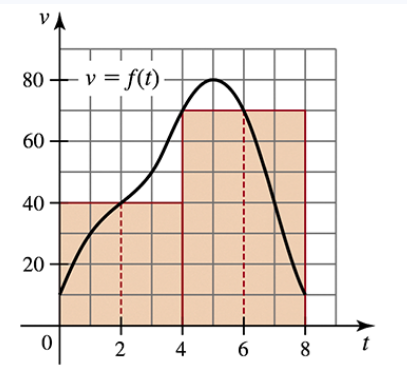
The velocity in ft/s of an object moving along a line is given by v = ƒ(t) on the interval 0 ≤ t ≤ 8 (see figure), where t is measured in seconds.
a) Divide the interval [0,8] into n = 2 subintervals, [0,4] and [4,8]. On each subinterval, assume the object moves at a constant velocity equal to the value of v evaluated at the midpoint of the subinterval, and use these approximations to estimate the displacement of the object on [0,8] (see part (a) of the figure)
Problem 5.3.96a
Working with area functions Consider the function ƒ and the points a, b, and c.
(a) Find the area function A (𝓍) = ∫ₐˣ ƒ(t) dt using the Fundamental Theorem.
ƒ(𝓍) = ― 12𝓍 (𝓍―1) (𝓍― 2) ; a = 0 , b = 1 , c = 2
Problem 5.4.46a
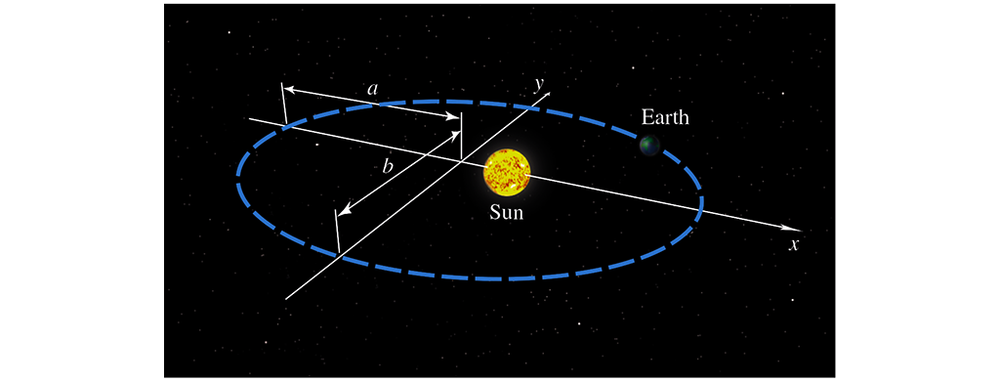
Planetary orbits The planets orbit the Sun in elliptical orbits with the Sun at one focus (see Section 12.4 for more on ellipses). The equation of an ellipse whose dimensions are 2a in the 𝓍-direction and 2b in the y-direction is (𝓍²/a²) + (y² /b²) = 1.
(a) Let d² denote the square of the distance from a planet to the center of the ellipse at (0, 0). Integrate over the interval [ ―a, a] to show that the average value of d² is (a² + 2b²) /3 .
Problem 5.4.53a
Average value with a parameter Consider the function ƒ(𝓍) = a𝓍 (1―𝓍) on the interval [0, 1], where a is a positive real number.
(a) Find the average value of ƒ as a function of a .
Problem 5.1.5a
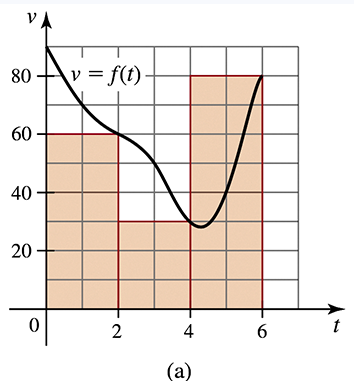
The velocity in ft/s of an object moving along a line is given by v = ƒ(t) on the interval 0 ≤ t ≤ 6 (see figure), where t is measured in seconds.
(a) Divide the interval [0,6] into n = 3 subintervals, [0,2] , [2,4] and [4,6]. On each subinterval, assume the object moves at a constant velocity equal to the value of v evaluated at the right endpoint of the subinterval, and use these approximations to estimate the displacement of the object on [0,6] (see part (a) of the figure)
Problem 5.1.49a
Sigma notation Evaluate the following expressions.
(a) 10
∑ κ
κ=1
Problem 5.2.57a
Using properties of integrals Use the value of the first integral I to evaluate the two given integrals.
I = ∫₀¹ (𝓍³ ― 2𝓍) d𝓍 = ―3/4
(a) ∫₀¹ (4𝓍―2𝓍³) d𝓍
Problem 5.1.59a
Explain why or why not Determine whether the following statements are true and give an explanation or counterexample.
(a) Consider the linear function ƒ(𝓍) = 2x + 5 and the region bounded by its graph and the x-axis on the interval [3,6]. Suppose the area of this region is approximated using midpoint Riemann sums. Then the approximations give the exact area of the region for any number of subintervals.
Problem 5.3.97a
Working with area functions Consider the function ƒ and the points a, b, and c.
(a) Find the area function A (𝓍) = ∫ₐˣ ƒ(t) dt using the Fundamental Theorem.
ƒ(𝓍) = cos 𝓍 ; a = 0 , b = π/2 , c = π
Problem 5.3.15a
Area functions for constant functions Consider the following functions ƒ and real numbers a (see figure).
(a) Find and graph the area function A(𝓍) = ∫ₐˣ ƒ(t) dt for ƒ.
ƒ(t) = 5 , a = 0
Problem 5.2.69a
Explain why or why not Determine whether the following statements are true and give an explanation or counterexample.
(a) If ƒ is a constant function on the interval [a,b], then the right and left Riemann sums give the exact value of ∫ₐᵇ ƒ(𝓍) d𝓍, for any positive integer n.
Problem 5.1.73a
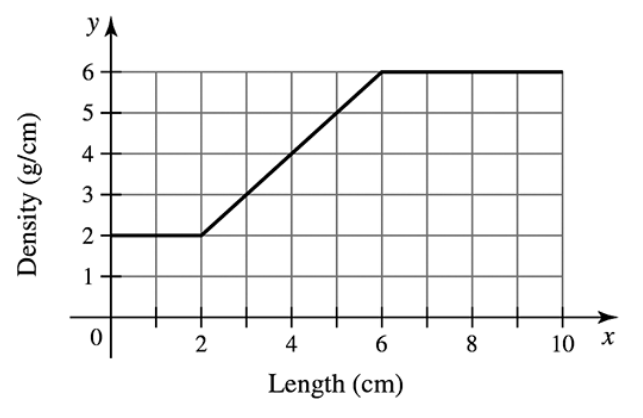
Mass from density A thin 10-cm rod is made of an alloy whose density varies along its length according to the function shown in the figure. Assume density is measured in units of g/cm. In Chapter 6, we show that the mass of the rod is the area under the density curve.
(a) Find the mass of the left half of the rod (0 ≤ x ≤ 5) .
Problem 5.4.58a
Bounds on an integral Suppose ƒ is continuous on [a, b] with ƒ''(𝓍) > 0 on the interval. It can be shown that (b―a) ƒ [(a + b) /2] ≤ ∫ₐᵇ ƒ(𝓍) d𝓍 ≤ (b―a) [ (ƒ(a) + ƒ(b)) /2]
(a) Assuming ƒ is nonnegative on [a, b], draw a figure to illustrate the geometric meaning of these inequalities. Discuss your conclusions. b.
Problem 5.1.35a
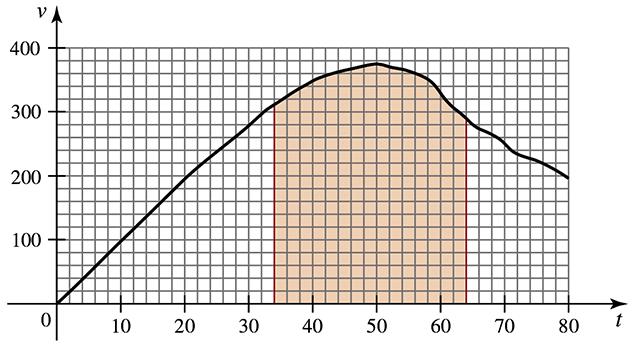
Free fall On October 14, 2012, Felix Baumgartner stepped off a balloon capsule at an altitude of almost 39 km above Earth’s surface and began his free fall. His velocity in m/s during the fall is given in the figure. It is claimed that Felix reached the speed of sound 34 seconds into his fall and that he continued to fall at supersonic speed for 30 seconds. (Source: http://www.redbullstratos.com)
(a) Divide the interval [34, 64] into n = 5 subintervals with the gridpoints x₀ = 34 , x₁ = 40 , x₂ = 46 , x₃ = 52 , x₄ = 58 , and x₅ = 64. Use left and right Riemann sums to estimate how far Felix fell while traveling at supersonic speed.
Problem 5.5.15b
Use Table 5.6 to evaluate the following indefinite integrals.
(b) ∫ sec 5𝓍 tan 5𝓍 d𝓍
Problem 5.2.71b
{Use of Tech} Approximating definite integrals with a calculator Consider the following definite integrals.
(b) Evaluate each sum using a calculator with n = 20, 50, and 100. Use these values to estimate the value of the integral.
∫₀¹ (𝓍² + 1) d𝓍
Problem 5.1.51b
{Use of Tech} Riemann sums for larger values of n Complete the following steps for the given function f and interval.
ƒ(𝓍) = 3 √x on [0,4] ; n = 40
(b) Based on the approximations found in part (a), estimate the area of the region bounded by the graph of f and the x-axis on the interval.