Back
Back
Problem 6.1.23a
{Use of Tech} Oscillating motion A mass hanging from a spring is set in motion, and its ensuing velocity is given by v(t) = 2π cos πt, for t≥0. Assume the positive direction is upward and s(0)=0.
a. Determine the position function, for t≥0.
Problem 6.5.27a
21–30. {Use of Tech} Arc length by calculator
a. Write and simplify the integral that gives the arc length of the following curves on the given interval.
y = cos 2x, for 0 ≤ x ≤ π
Problem 6.1.47a
Depletion of natural resources Suppose r(t) = r0e^−kt, with k>0, is the rate at which a nation extracts oil, where r0=10⁷ barrels/yr is the current rate of extraction. Suppose also that the estimate of the total oil reserve is 2×10⁹ barrels.
a. Find Q(t), the total amount of oil extracted by the nation after t years.
Problem 6.7.65a
Critical depth A large tank has a plastic window on one wall that is designed to withstand a force of 90,000 N. The square window is 2 m on a side, and its lower edge is 1 m from the bottom of the tank.
a. If the tank is filled to a depth of 4 m, will the window withstand the resulting force?
Problem 6.4.72a
Explain the steps required to find the length of a curve x = g(y) between y=c and y=d.
Problem 6.1.46a
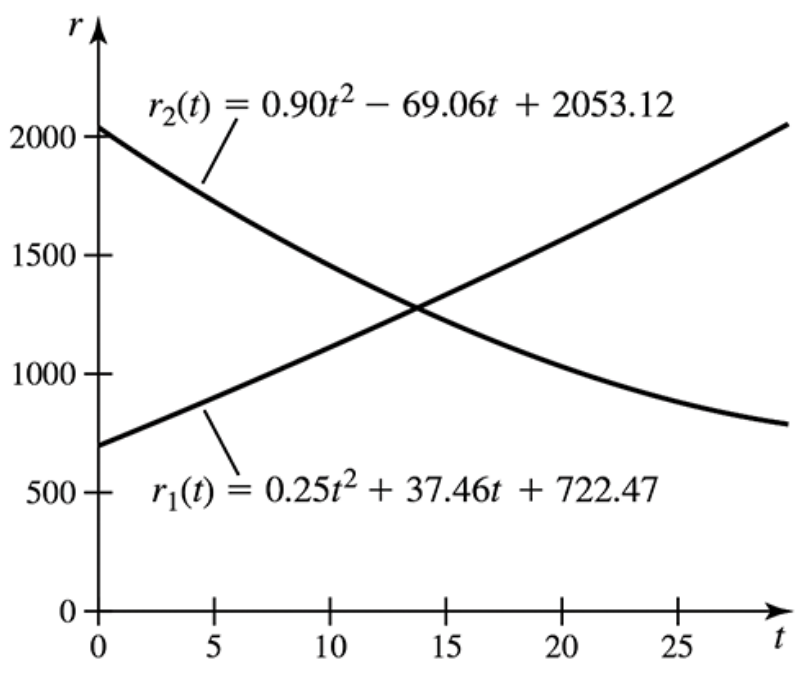
Flow rates in the Spokane River The daily discharge of the Spokane River as it flows through Spokane, Washington, in April and June is modeled by the functions
r1(t) = 0.25t²+37.46t+722.47 (April) and
r2(t) = 0.90t²−69.06t+2053.12 (June), where the discharge is measured in millions of cubic feet per day, and t=0 corresponds to the beginning of the first day of the month (see figure).
a. Determine the total amount of water that flows through Spokane in April (30 days).
Problem 6.3.61a
"Determine whether the following statements are true and give an explanation or counterexample.
a. A pyramid is a solid of revolution. "
Problem 6.1.52a
Oscillating growth rates Some species have growth rates that oscillate with an (approximately) constant period P. Consider the growth rate function N'(t) = r+A sin 2πt/P, where A and r are constants with units of individuals/yr, and t is measured in years. A species becomes extinct if its population ever reaches 0 after t=0.
a. Suppose P=10, A=20, and r=0. If the initial population is N(0)=10, does the population ever become extinct? Explain.
Problem 6.1.45a
Oil production An oil refinery produces oil at a variable rate given by Q'(t) = <1x3 matrix>, where is measured in days and is measured in barrels.
a. How many barrels are produced in the first 35 days?
Problem 6.1.48a
Filling a tank A 2000-liter cistern is empty when water begins flowing into it (at t=0 at a rate (in L/min) given by Q′(t) = 3√t, where t is measured in minutes.
a. How much water flows into the cistern in 1 hour?
Problem 6.1.18a
17–22. Position from velocity Consider an object moving along a line with the given velocity v and initial position.
a. Determine the position function, for t≥0, using the antiderivative method
v(t) = −t³+3t²−2t on [0, 3]; s(0)=4
Problem 6.7.58a
Mass of two bars Two bars of length L have densities ρ₁(x) = 4e^−x and ρ₂(x) = 6e^−2x, for 0≤x≤L.
a. For what values of L is bar 1 heavier than bar 2?
Problem 6.7.31a
Winding a chain A 30-m-long chain hangs vertically from a cylinder attached to a winch. Assume there is no friction in the system and the chain has a density of 5kg/m.
a. How much work is required to wind the entire chain onto the cylinder using the winch?
Problem 6.6.23a
Determine whether the following statements are true and give an explanation or counterexample.
a. If the curve y=f(x) on the interval [a, b] is revolved about the y-axis, the area of the surface generated is ∫f(b)f(a) 2πf(y)√1+f′(y)^2 dy.
Problem 6.1.16a
13–16. Displacement from velocity Consider an object moving along a line with the given velocity v. Assume time t is measured in seconds and velocities have units of m/s.
a. Determine when the motion is in the positive direction and when it is in the negative direction.
v(t) = 50e^−2t on [0, 4]
Problem 6.1.10a
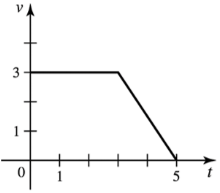
9–10. Velocity graphs The figures show velocity functions for motion along a line. Assume the motion begins with an initial position of s(0)=0. Determine the following.
a. The displacement between t=0 and t=5
Problem 6.1.21a
17–22. Position from velocity Consider an object moving along a line with the given velocity v and initial position.
a. Determine the position function, for t≥0, using the antiderivative method
v(t) = 9−t² on [0, 4]; s(0)=−2
Problem 6.2.5a
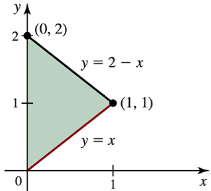
Find the area of the region (see figure) in two ways.
a. Using integration with respect to x.
Problem 6.4.49a
Volume of a sphere Let R be the region bounded by the upper half of the circle x²+y² = r² and the x-axis. A sphere of radius r is obtained by revolving R about the x-axis.
a. Use the shell method to verify that the volume of a sphere of radius r is 4/3 πr³.
Problem 6.5.29a
21–30. {Use of Tech} Arc length by calculator
a. Write and simplify the integral that gives the arc length of the following curves on the given interval.
y = 1/x, for 1 ≤ x ≤ 10
Problem 6.7.42a
Emptying a water trough A water trough has a semicircular cross section with a radius of 0.25 m and a length of 3 m (see figure).
a. How much work is required to pump the water out of the trough (to the level of the top of the trough) when it is full?
Problem 6.2.65a
Determine whether the following statements are true and give an explanation or counterexample.
a. The area of the region bounded by y=x and x=y^2 can be found only by integrating with respect to x.
Problem 6.6.5a
A surface is generated by revolving the line f(x)=2−x, for 0≤x≤2, about the x-axis. Find the area of the resulting surface in the following ways.
a. Using calculus
Problem 6.6.39a
In the design of solid objects (both artificial and natural), the ratio of the surface area to the volume of the object is important. Animals typically generate heat at a rate proportional to their volume and lose heat at a rate proportional to their surface area. Therefore, animals with a low SAV ratio tend to retain heat, whereas animals with a high SAV ratio (such as children and hummingbirds) lose heat relatively quickly.
a. What is the SAV ratio of a cube with side lengths a?
Problem 6.7.69a
Work in a gravitational field For large distances from the surface of Earth, the gravitational force is given by F(x) = GMm / (x+R)², where G = 6.7×10^−11 N m²/kg² is the gravitational constant, M = 6×10^24 kg is the mass of Earth, m is the mass of the object in the gravitational field, R = 6.378×10⁶ m is the radius of Earth, and x≥0 is the distance above the surface of Earth (in meters).
a. How much work is required to launch a rocket with a mass of 500 kg in a vertical flight path to a height of 2500 km (from Earth’s surface)?
Problem 6.5.35b
Functions from arc length What differentiable functions have an arc length on the interval [a, b] given by the following integrals? Note that the answers are not unique. Give a family of functions that satisfy the conditions.
b. ∫a^b √1+36 cos² 2xdx
Problem 6.7.25b
Work done by a spring A spring on a horizontal surface can be stretched and held 0.5 m from its equilibrium position with a force of 50 N.
b. How much work is done in compressing the spring 0.5 m from its equilibrium position?
Problem 6.3.7b
Use the region R that is bounded by the graphs of y=1+√x,x=4, and y=1 complete the exercises.
Region R is revolved about the x-axis to form a solid of revolution whose cross sections are washers.
b. What is the inner radius of a cross section of the solid at a point x in [0, 4]?
Problem 6.7.39b
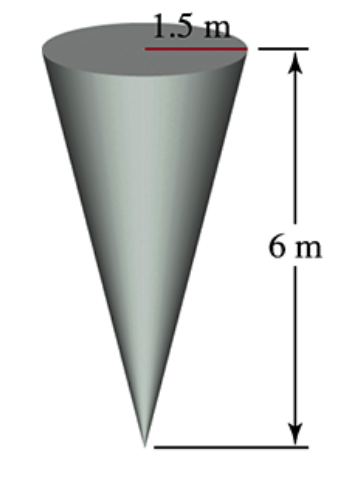
Emptying a conical tank A water tank is shaped like an inverted cone with height 6 m and base radius 1.5 m (see figure).
b. Is it true that it takes half as much work to pump the water out of the tank when it is filled to half its depth as when it is full? Explain.
Problem 6.4.72b
Equal integrals Without evaluating integrals, explain the following equalities. (Hint: Draw pictures.)
b. ∫²₀(25−(x²+1)²) dx = 2∫₁⁵ y√y−1 dy