Back
Back
Problem 4.7.85
Initial Value Problems
Solve the initial value problems in Exercises 71–90.
d²r/dt² = 2/t³; dr/dt|ₜ ₌ ₁ =1, r(1) = 1
Problem 4.2.47
Finding Position from Velocity or Acceleration
Exercises 45–48 give the acceleration a=d²s/dt², initial velocity, and initial position of an object moving on a coordinate line. Find the object’s position at time t.
a = 9.8, v(0) = −3, s(0) = 0
Problem 4.7.23
Finding Indefinite Integrals
In Exercises 17–56, find the most general antiderivative or indefinite integral. You may need to try a solution and then adjust your guess. Check your answers by differentiation.
∫(1/x² − x² − 1/3) dx
Problem 4.7.41
Finding Indefinite Integrals
In Exercises 17–56, find the most general antiderivative or indefinite integral. You may need to try a solution and then adjust your guess. Check your answers by differentiation.
∫(cscθ cotθ) / 2 dθ
Problem 4.6.5
Root Finding
5. Use Newton's method to find the positive fourth root of 2 by solving the equation x^4 -2 = 0. Start with x_0 = 1 and find x_2.
Problem 4.4.53
In Exercises 9–66, graph the function using appropriate methods from the graphing procedures presented just before Example 9, identifying the coordinates of any local extreme points and inflection points. Then find coordinates of absolute extreme points, if any.
53. y = x * √(8 - x²)
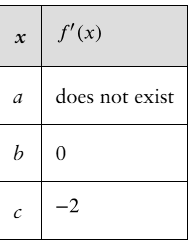
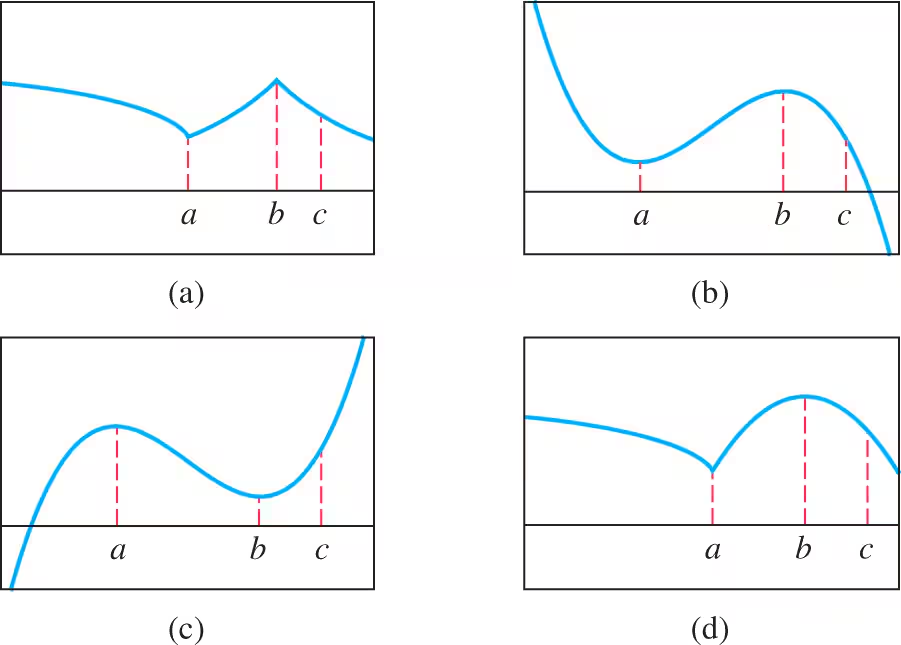
Problem 4.1.13
Finding Extrema from Graphs
In Exercises 11–14, match the table with a graph.
Problem 4.3.35
Identifying Extrema
In Exercises 19–40:
a. Find the open intervals on which the function is increasing and those on which it is decreasing.
b. Identify the function’s local extreme values, if any, saying where they occur.
f(x) = (x² − 3) / (x − 2), x ≠ 2
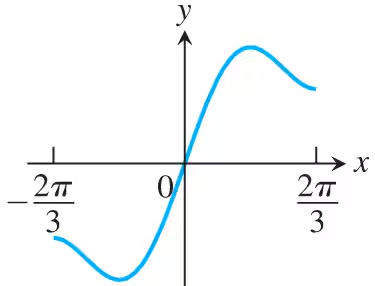
Problem 4.4.5
Identify the inflection points and local maxima and minima of the functions graphed in Exercises 1–8. Identify the open intervals on which the functions are differentiable and the graphs are concave up and concave down.
5. y=x+sin(2x), -2π/3≤x≤2π/3
Problem 4.7.19
Finding Indefinite Integrals
In Exercises 17–56, find the most general antiderivative or indefinite integral. You may need to try a solution and then adjust your guess. Check your answers by differentiation.
∫(3t² + t/2) dt
Problem 4.4.113
113. If b, c, and d are constants, for what value of b will the curve y = x^3 + bx^2 + cx + d have a
point of inflection at x = 1? Give reasons for your answer.
Problem 4.8
In Exercises 1–10, find the extreme values (absolute and local) of the function over its natural domain, and where they occur.
__________
y = √ 3 + 2𝓍 ―𝓍²
Problem 4.4.110
110. Suppose the derivative of the function y = f(x) is
y'=(x-1)^22(x-2)(x-4).
At what points, if any, does the graph of f have a local minimum, local maximum, or
point of inflection?
Problem 4.7.45
Finding Indefinite Integrals
In Exercises 17–56, find the most general antiderivative or indefinite integral. You may need to try a solution and then adjust your guess. Check your answers by differentiation.
∫(sin2x − csc²x)dx
Problem 4.1.17
Finding Extrema from Graphs
In Exercises 15–20, sketch the graph of each function and determine whether the function has any absolute extreme values on its domain. Explain how your answer is consistent with Theorem 1.
g(x) = {−x, 0 ≤ x < 1
x − 1, 1 ≤ x ≤ 2
Problem 4.7.81
Initial Value Problems
Solve the initial value problems in Exercises 71–90.
dv/dt = (1/2)sec t tan t, v(0) = 1
Problem 4.7.43
Finding Indefinite Integrals
In Exercises 17–56, find the most general antiderivative or indefinite integral. You may need to try a solution and then adjust your guess. Check your answers by differentiation.
∫(4secx tanx − 2 sec²x)dx
Problem 4.2.20
Roots (Zeros)
Show that the functions in Exercises 19–26 have exactly one zero in the given interval.
f(x) = x³ + 4x² + 7, (−∞, 0)
Problem 4.5.47
The intensity of illumination at any point from a light source is proportional to the square of the reciprocal of the distance between the point and the light source. Two lights, one having an intensity eight times that of the other, are 6 m apart. How far from the stronger light is the total illumination least?
Problem 4.7.58
Checking Antiderivative Formulas
Verify the formulas in Exercises 57–62 by differentiation.
∫(3x + 5)⁻² dx = −(3x + 5)⁻¹/3 + C
Problem 4.4.71
Each of Exercises 67–88 gives the first derivative of a continuous function y=f(x). Find y'' and then use Steps 2–4 of the graphing procedure described in this section to sketch the general shape of the graph of f.
71. y' = x(x² - 12)
Problem 4.3.73
Theory and Examples
Determine the values of constants a and b so that f(x) = ax² + bx has an absolute maximum at the point (1,2).
Problem 4.2
Finding Extreme Values
In Exercises 1–10, find the extreme values (absolute and local) of the function over its natural domain, and where they occur.
y = 𝓍³ ― 2𝓍 + 4
Problem 4.5.62
Business and Economics
62. Production level Suppose that c(x)=x^3-20x^2 + 20,000x is the cost of manufacturing x items. Find a production level that will minimize the average cost of making x items.
Problem 4.30
Estimate the open intervals on which the function y = ƒ(𝓍) is
a. increasing.
b. decreasing.
c. Use the given graph of ƒ' to indicate where any local extreme
values of the function occur, and whether each extreme
is a relative maximum or minimum.
<IMAGE>
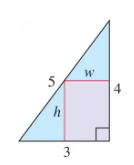
Problem 4.5.35
35. Determine the dimensions of the rectangle of largest area that can be inscribed in the right triangle shown in the accompanying figure.
Problem 4.6.2
Root Finding
2. Use Newton's method to estimate the one real solution of x^3 +3x + 1 = 0. Start with x_0 = 0 and then find x_2.
Problem 4.2.12
Checking the Mean Value Theorem
Which of the functions in Exercises 7–12 satisfy the hypotheses of the Mean Value Theorem on the given interval, and which do not? Give reasons for your answers.
f(x) = {2x − 3, 0 ≤ x ≤ 2
6x − x² − 7, 2 < x ≤ 3
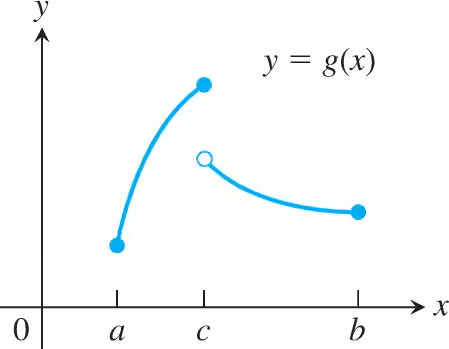
Problem 4.1.5
Finding Extrema from Graphs
In Exercises 1–6, determine from the graph whether the function has any absolute extreme values on [a, b]. Then explain how your answer is consistent with Theorem 1.
Problem 4.2.24
Roots (Zeros)
Show that the functions in Exercises 19–26 have exactly one zero in the given interval.
r(θ) = 2θ − cos²θ + √2, (−∞, ∞)