Back
Back
Problem 5
Find the domain of each function. f(x) = x² - 2x - 15
Problem 19
Find the domain of each function. f(x) = 1/√(x - 3)
Problem 21
Find the domain of each function. f(x) = √(5x+35)
Problem 31a
Find ƒ+g and determine the domain for each function. f(x) = 2x + 3, g(x) = x − 1
Problem 31b
Find f−g and determine the domain for each function. f(x) = 2x + 3, g(x) = x − 1
Problem 31c
Find fg and determine the domain for each function. f(x) = 2x + 3, g(x) = x − 1
Problem 31d
Find f/g and determine the domain for each function. f(x) = 2x + 3, g(x) = x − 1
Problem 33
Find f−g and determine the domain for each function. f(x) = x -5, g(x) = 3x²
Problem 47
Find ƒ+g and determine the domain for each function. f(x) = √(x +4), g(x) = √(x − 1)
Problem 69
Find a. (fog) (x) b. the domain of f o g. f(x) = x/(x+1), g(x) = 4/x
Problem 95
Find all values of x satisfying the given conditions. f(x) = 2x − 5, g(x) = x² − 3x + 8, and (ƒ o g) (x) = 7.
Problem 1
Find f(g(x)) and g (f(x)) and determine whether each pair of functions ƒ and g are inverses of each other. f(x) = 4x and g(x) = x/4
Problem 3
Find f(g(x)) and g (f(x)) and determine whether each pair of functions ƒ and g are inverses of each other. f(x)=3x+8 and g(x) = (x-8)/3
Problem 4
Find f(g(x)) and g (f(x)) and determine whether each pair of functions ƒ and g are inverses of each other. f(x) = 4x + 9 and g(x) = (x-9)/4
Problem 5
Find f(g(x)) and g (f(x)) and determine whether each pair of functions ƒ and g are inverses of each other. f(x)=5x-9 and g(x) = (x+5)/9
Problem 7
Find f(g(x)) and g (f(x)) and determine whether each pair of functions ƒ and g are inverses of each other. f(x) = 3/(x-4) and g(x) = (3/x) + 4
Problem 9
Find f(g(x)) and g (f(x)) and determine whether each pair of functions ƒ and g are inverses of each other. f(x) = = -x and g(x) = -x
Problem 10
Find f(g(x)) and g (f(x)) and determine whether each pair of functions ƒ and g are inverses of each other. f(x) = ∛(x − 4) and g(x) = x³ +4
Problem 11
The functions in Exercises 11-28 are all one-to-one. For each function, a. Find an equation for f-1(x), the inverse function. b. Verify that your equation is correct by showing that f(ƒ-1 (x)) = = x and ƒ-1 (f(x)) = x. f(x) = x +3
Problem 13
The functions in Exercises 11-28 are all one-to-one. For each function, a. Find an equation for f-1(x), the inverse function. b. Verify that your equation is correct by showing that f(ƒ-1 (x)) = = x and ƒ-1 (f(x)) = x. f(x) = 2x
Problem 15
The functions in Exercises 11-28 are all one-to-one. For each function, a. Find an equation for f-1(x), the inverse function. b. Verify that your equation is correct by showing that f(ƒ-1 (x)) = = x and ƒ-1 (f(x)) = x. f(x) = 2x + 3
Problem 17
The functions in Exercises 11-28 are all one-to-one. For each function, a. Find an equation for f-1(x), the inverse function. b. Verify that your equation is correct by showing that f(ƒ-1 (x)) = = x and ƒ-1 (f(x)) = x. f(x) = x³ +2
Problem 19
The functions in Exercises 11-28 are all one-to-one. For each function, a. Find an equation for f-1(x), the inverse function. b. Verify that your equation is correct by showing that f(ƒ-1 (x)) = = x and ƒ-1 (f(x)) = x. f(x) = (x+2)³
Problem 21
The functions in Exercises 11-28 are all one-to-one. For each function, a. Find an equation for f-1(x), the inverse function. b. Verify that your equation is correct by showing that f(ƒ-1 (x)) = = x and ƒ-1 (f(x)) = x. f(x) = 1/x
Problem 23
The functions in Exercises 11-28 are all one-to-one. For each function, a. Find an equation for f-1(x), the inverse function. b. Verify that your equation is correct by showing that f(ƒ-1 (x)) = = x and ƒ-1 (f(x)) = x. f(x) = √x
Problem 25
The functions in Exercises 11-28 are all one-to-one. For each function, a. Find an equation for f-1(x), the inverse function. b. Verify that your equation is correct by showing that f(ƒ-1 (x)) = = x and ƒ-1 (f(x)) = x. f(x) = (x +4)/(x-2)
Problem 27
The functions in Exercises 11-28 are all one-to-one. For each function, a. Find an equation for f-1(x), the inverse function. b. Verify that your equation is correct by showing that f(ƒ-1 (x)) = = x and ƒ-1 (f(x)) = x. f(x) = (2x +1)/(x-3)
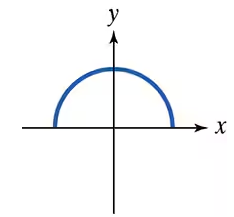
Problem 29
Which graphs in Exercises 29–34 represent functions that have inverse functions?
Problem 31
Which graphs in Exercises 29–34 represent functions that have inverse functions?
Problem 33
Which graphs in Exercises 29–34 represent functions that have inverse functions?