Back
Back
Problem 10.6.63
45–63. Absolute and conditional convergence Determine whether the following series converge absolutely, converge conditionally, or diverge.
∑ (k = 1 to ∞) (−1)ᵏ⁺¹ · (k!) / (kᵏ) (Hint: Show that k! / kᵏ ≤ 2 / k², for k ≥ 3.)
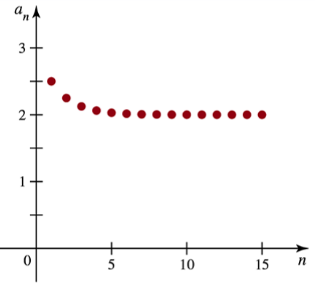
Problem 10.1.49
49–50. Limits from graphs Consider the following sequences. Find the first four terms of the sequence .Based on part (a) and the figure, determine a plausible limit of the sequence.
aₙ = 2 + 2⁻ⁿ ; n = 1, 2, 3, …
Problem 10.4.35
23–38. Divergence, Integral, and p-series Tests Use the Divergence Test, the Integral Test, or the p-series test to determine whether the following series converge.
∑ (k = 1 to ∞) (k / (k + 10))ᵏ
Problem 10.4.9
9–16. Divergence Test Use the Divergence Test to determine whether the following series diverge or state that the test is inconclusive.
∑ (k = 0 to ∞) k / (2k + 1)
Problem 10.2.65
55–70. More sequences
Find the limit of the following sequences or determine that the sequence diverges.
{cos n / n}
Problem 10.8.45
11–86. Applying convergence tests Determine whether the following series converge. Justify your answers.
∑ (from k = 1 to ∞) k⁴ / (eᵏ⁵)
Problem 10.6.57
45–63. Absolute and conditional convergence Determine whether the following series converge absolutely, converge conditionally, or diverge.
∑ (k = 1 to ∞) (−1)ᵏ · k / (2k + 1)
Problem 10.7.5
Simplify k! / (k + 2)! for any integer k ≥ 0.
Problem 10.3.23
21–42. Geometric series Evaluate each geometric series or state that it diverges.
23. ∑ (k = 0 to ∞) (–9/10)ᵏ
Problem 10.5.11
9–36. Comparison tests Use the Comparison Test or the Limit Comparison Test to determine whether the following series converge.
∑ (k = 1 to ∞) (k² − 1) / (k³ + 4)
Problem 10.7.9
9–30. The Ratio and Root Tests Use the Ratio Test or the Root Test to determine whether the following series converge absolutely or diverge.
∑ (from k = 1 to ∞) ((-1)ᵏ) / (k!)
Problem 10.3.91
{Use of Tech} For what value of r does
∑ (k = 3 to ∞) r²ᵏ = 10?
Problem 10.3.57
54–69. Telescoping series
For the following telescoping series, find a formula for the nth term of the sequence of partial sums {Sₙ}. Then evaluate limₙ→∞ Sₙ to obtain the value of the series or state that the series diverges.
57. ∑ (k = 1 to ∞) 1 / ((k + 6)(k + 7))
Problem 10.6.49
45–63. Absolute and conditional convergence Determine whether the following series converge absolutely, converge conditionally, or diverge.
∑ (k = 1 to ∞) (3/4)ᵏ
Problem 10.8.9
1–10. Choosing convergence tests Identify a convergence test for each series. If necessary, explain how to simplify or rewrite the series before applying the convergence test. You do not need to carry out the convergence test.
∑ (from k = 1 to ∞) ((−1)ᵏ⁺¹) / (√2ᵏ + ln k)
Problem 10.1.53
51–56. {Use of Tech} Recurrence relations Consider the following recurrence relations. Make a table with at least ten terms and determine a plausible limit of the sequence or state that the sequence diverges.
aₙ₊₁ = 4aₙ + 1 a₀ = 1
Problem 10.3.43
43–44. Periodic doses
Suppose you take a dose of m mg of a particular medication once per day. Assume f equals the fraction of the medication that remains in your blood one day later. Just after taking another dose of medication on the second day, the amount of medication in your blood equals the sum of the second dose and the fraction of the first dose remaining in your blood, which is m + mf. Continuing in this fashion, the amount of medication in your blood just after your nth dose is
Aₙ = m + mf + ⋯ + mfⁿ⁻¹.
For the given values of f and m, calculate A₅, A₁₀, A₃₀, and lim (n → ∞) Aₙ. Interpret the meaning of the limit lim (n → ∞) Aₙ.
43. f = 0.25, m = 200 mg
Problem 10.3.97
Property of divergent series Prove Property 2 of Theorem 10.8: If ∑ aₖ diverges, then ∑ c aₖ also diverges, for any real number c ≠ 0.
Problem 10.8.47
11–86. Applying convergence tests Determine whether the following series converge. Justify your answers.
∑ (from k = 1 to ∞) (4k)! / (k!)⁴
Problem 10.4.33
23–38. Divergence, Integral, and p-series Tests Use the Divergence Test, the Integral Test, or the p-series test to determine whether the following series converge.
∑ (k = 1 to ∞) k / eᵏ
Problem 10.8.73
11–86. Applying convergence tests Determine whether the following series converge. Justify your answers.
∑ (from k = 0 to ∞) k² · 1.001⁻ᵏ
Problem 10.5.23
9–36. Comparison tests Use the Comparison Test or the Limit Comparison Test to determine whether the following series converge.
∑ (k = 1 to ∞) sin(1 / k) / k²
Problem 10.7.17
9–30. The Ratio and Root Tests Use the Ratio Test or the Root Test to determine whether the following series converge absolutely or diverge.
∑ (from k = 1 to ∞) ((-7)ᵏ / k²)
Problem 10.7.45
32–49. Choose your test Use the test of your choice to determine whether the following series converge absolutely, converge conditionally, or diverge.
∑ (from k = 1 to ∞) (−1)ᵏ / k⁰.⁹⁹
Problem 10.17
9–36. Comparison tests Use the Comparison Test or the Limit Comparison Test to determine whether the following series converge.
∑ (k = 1 to ∞) 1 / (k³ᐟ² + 1)
Problem 10.5.3
What comparison series would you use with the Comparison Test to determine whether
∑ (k = 1 to ∞) 1 / (k² + 1) converges?
Problem 10.6.55
45–63. Absolute and conditional convergence Determine whether the following series converge absolutely, converge conditionally, or diverge.
∑ (k = 1 to ∞) (−1)ᵏ⁺¹ / (2√k − 1)
Problem 10.6.43
39–44. {Use of Tech} Estimating infinite series Estimate the value of the following convergent series with an absolute error less than 10⁻³.
∑ (k = 1 to ∞) (−1)ᵏ / kᵏ
Problem 10.2.77
Growth rates of sequences
Use Theorem 10.6 to find the limit of the following sequences or state that they diverge.
{n¹⁰ / ln 20 n}
Problem 10.8.69
11–86. Applying convergence tests Determine whether the following series converge. Justify your answers.
∑ (from k = 1 to ∞) (1 + 1 / (2k))ᵏ