Back
Back
Problem 5.5.49
Definite integrals Use a change of variables or Table 5.6 to evaluate the following definite integrals.
∫₁³ ( 2ˣ / 2ˣ + 4 ) d𝓍
Problem 5.2.67
Use geometry and properties of integrals to evaluate
∫₀¹ (2𝓍 + √(1―𝓍²) + 1) d𝓍
Problem 5.3.2
Suppose F is an antiderivative of ƒ and A is an area function of ƒ. What is the relationship between F and A?
Problem 5.2.65
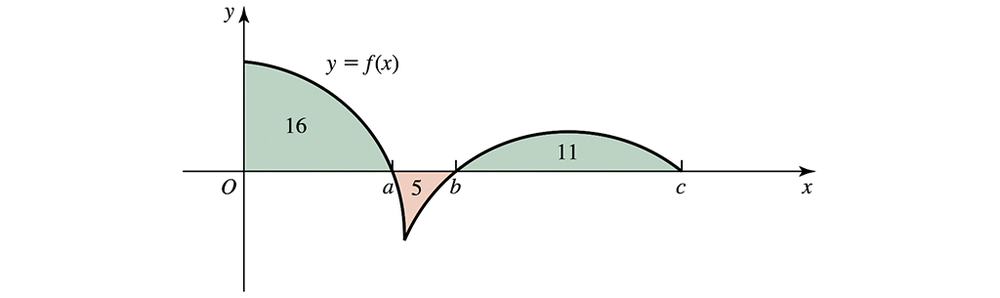
Definite integrals from graphs The figure shows the areas of regions bounded by the graph of ƒ and the 𝓍-axis. Evaluate the following integrals.
∫ₐ⁰ ƒ(𝓍) d𝓍
Problem 5.5.36
Indefinite integrals Use a change of variables or Table 5.6 to evaluate the following indefinite integrals. Check your work by differentiating.
∫ sec 4w tan 4w dw
Problem 5.3.55
Definite integrals Evaluate the following integrals using the Fundamental Theorem of Calculus
∫π/₄^³π/⁴ (cot² 𝓍 + 1) d𝓍
Problem 5.3.5
The linear function ƒ(𝓍) = 3 ― 𝓍 is decreasing on the interval [0, 3]. Is its area function for ƒ (with left endpoint 0) increasing or decreasing on the interval [0, 3]? Draw a picture and explain.
Problem 5.5.79
Variations on the substitution method Evaluate the following integrals.
∫ 𝓍/(√𝓍―4) d𝓍
Problem 5.1.67
Identifying Riemann sums Fill in the blanks with an interval and a value of n.
4
∑ ƒ (1.5 + k) • 1 is a midpoint Riemann sum for f on the interval [ ___ , ___ ]
k = 1
with n = ________ .
Problem 5.5.10
Use the given substitution to evaluate the following indefinite integrals. Check your answer by differentiating.
∫ (6𝓍 + 1) √(3𝓍² + 𝓍) d𝓍 , u = 3𝓍² + 𝓍
Problem 5.2.59
Definite integrals from graphs The figure shows the areas of regions bounded by the graph of ƒ and the 𝓍-axis. Evaluate the following integrals.
∫₀ᵃ ƒ(𝓍) d𝓍
Problem 5.5.18
Indefinite integrals Use a change of variables or Table 5.6 to evaluate the following indefinite integrals. Check your work by differentiating.
∫ 𝓍eˣ² d𝓍
Problem 5.3.66
Area Find (i) the net area and (ii) the area of the following regions. Graph the function and indicate the region in question.
The region bounded by y = 6 cos 𝓍 and the 𝓍-axis between 𝓍 = ―π/2 and 𝓍 = π
Problem 5.2.79
Limits of sums Use the definition of the definite integral to evaluate the following definite integrals. Use right Riemann sums and Theorem 5.1.
∫₀² (2𝓍 + 1) d𝓍
Problem 5.1.19
Approximating displacement The velocity of an object is given by the following functions on a specified interval. Approximate the displacement of the object on this interval by subdividing the interval into n subintervals. Use the left endpoint of each subinterval to compute the height of the rectangles.
v = [1 / (2t + 1)] (m/s), for 0 ≤ t ≤ 8 ; n = 4
Problem 5.1.75
Displacement from velocity The following functions describe the velocity of a car (in mi/hr) moving along a straight highway for a 3-hr interval. In each case, find the function that gives the displacement of the car over the interval [0,t], where 0 ≤ t ≤ 3.
v(t) = { 30 if 0 ≤ t ≤ 2
50 if 2 < t < 2.5
44 if 2.5 < t ≤ 3
Problem 5.5.46
Definite integrals Use a change of variables or Table 5.6 to evaluate the following definite integrals.
∫₀¹ 2e²ˣ d𝓍
Problem 5.3.23
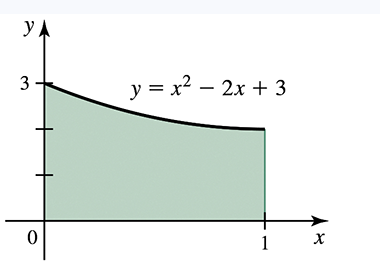
Definite integrals Evaluate the following integrals using the Fundamental Theorem of Calculus. Explain why your result is consistent with the figure.
∫₀¹ (𝓍² ― 2𝓍 + 3) d𝓍
Problem 5.3.103
{Use of Tech} Areas of regions Find the area of the region 𝑅 bounded by the graph of ƒ and the 𝓍-axis on the given interval. Graph ƒ and show the region 𝑅.
ƒ(𝓍) = 2 ― |𝓍| on [ ― 2 , 4]
Problem 5.1.63
{Use of Tech} Sigma notation for Riemann sums Use sigma notation to write the following Riemann sums. Then evaluate each Riemann sum using Theorem 5.1 or a calculator.
The midpoint Riemann sum for f(x) = x³ on [3,11] with n = 32.
Problem 5.3.8
Why can the constant of integration be omitted from the antiderivative when evaluating a definite integral?
Problem 5.5.59
Definite integrals Use a change of variables or Table 5.6 to evaluate the following definite integrals.
∫₂/₍₅√₃₎^²/⁵ d𝓍/ x√(25𝓍²― 1)
Problem 5.3.114
Max/min of area functions Suppose ƒ is continuous on [0 ,∞) and A(𝓍) is the net area of the region bounded by the graph of ƒ and the t-axis on [0, x]. Show that the local maxima and minima of A occur at the zeros of ƒ. Verify this fact with the function ƒ(𝓍) = 𝓍² - 10𝓍.
Problem 5.2.83
Limits of sums Use the definition of the definite integral to evaluate the following definite integrals. Use right Riemann sums and Theorem 5.1.
∫₁⁴ (𝓍²―1) d𝓍
Problem 5.5.96
Areas of regions Find the area of the following regions.
The region bounded by the graph of ƒ(𝓍) = x /√(𝓍² ―9) and the 𝓍-axis between and 𝓍 = 4 and 𝓍= 5
Problem 5.3.27
Definite integrals Evaluate the following integrals using the Fundamental Theorem of Calculus. Sketch the graph of the integrand and shade the region whose net area you have found.
∫₀⁵ (𝓍²―9) d𝓍
Problem 5.2.43
Definite integrals Use geometry (not Riemann sums) to evaluate the following definite integrals. Sketch a graph of the integrand, show the region in question, and interpret your result.
∫₀⁴ √(16― 𝓍² ) d𝓍
Problem 5.4.47
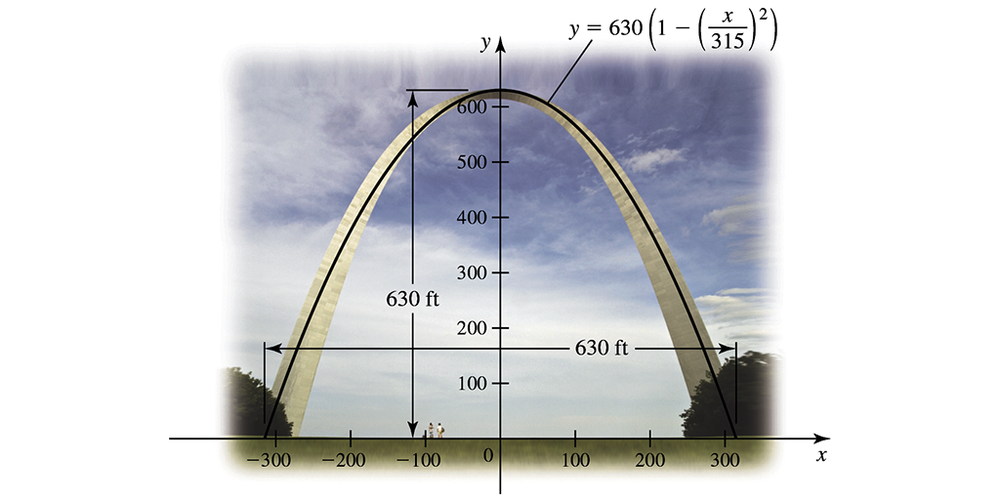
Gateway Arch The Gateway Arch in St. Louis is 630 ft high and has a 630-ft base. Its shape can be modeled by the parabola y = 630 (1― (𝓍/315)²) . Find the average height of the arch above the ground.
Problem 5.5.84
Variations on the substitution method Evaluate the following integrals.
∫ (𝒵 + 1) √(3𝒵 + 2) d𝒵
Problem 5.2.37
Identifying definite integrals as limits of sums Consider the following limits of Riemann sums for a function ƒ on [a,b]. Identify ƒ and express the limit as a definite integral.
n
lim ∑ 𝓍*ₖ (ln 𝓍*ₖ) ∆𝓍ₖ on [1,2]
∆ → 0 k=1