Back
Back
Problem 6.7.27a
Calculating work for different springs Calculate the work required to stretch the following springs 0.5m from their equilibrium positions. Assume Hooke’s law is obeyed.
a. A spring that requires a force of 50 N to be stretched 0.2 m from its equilibrium position
Problem 6.1.7a
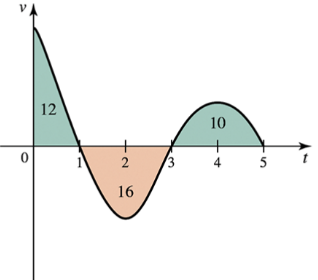
Displacement and distance from velocity Consider the graph shown in the figure, which gives the velocity of an object moving along a line. Assume time is measured in hours and distance is measured in miles. The areas of three regions bounded by the velocity curve and the t-axis are also given.
a. On what intervals is the object moving in the positive direction?
Problem 6.1.57a
55–58. Marginal cost Consider the following marginal cost functions.
a. Find the additional cost incurred in dollars when production is increased from 100 units to 150 units.
C′(x) = 300+10x−0.01x²
Problem 6.7.36a
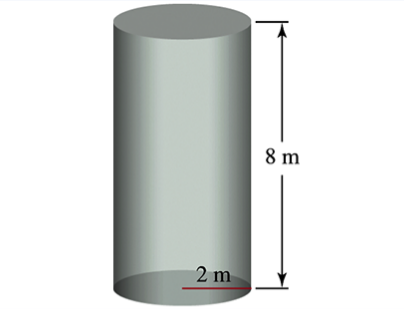
Emptying a cylindrical tank A cylindrical water tank has height 8 m and radius 2m (see figure).
a. If the tank is full of water, how much work is required to pump the water to the level of the top of the tank and out of the tank?
Problem 6.5.35a
Functions from arc length What differentiable functions have an arc length on the interval [a, b] given by the following integrals? Note that the answers are not unique. Give a family of functions that satisfy the conditions.
a. ∫a^b √1+16x⁴ dx
Problem 6.1.9a
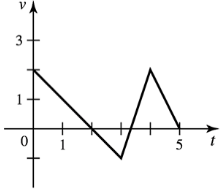
9–10. Velocity graphs The figures show velocity functions for motion along a line. Assume the motion begins with an initial position of s(0)=0. Determine the following.
a. The displacement between t=0 and t=5
Problem 6.1.55a
55–58. Marginal cost Consider the following marginal cost functions.
a. Find the additional cost incurred in dollars when production is increased from 100 units to 150 units.
C′(x)=200−0.05x
Problem 6.2.65a
Determine whether the following statements are true and give an explanation or counterexample.
a. The area of the region bounded by y=x and x=y^2 can be found only by integrating with respect to x.
Problem 6.6.5a
A surface is generated by revolving the line f(x)=2−x, for 0≤x≤2, about the x-axis. Find the area of the resulting surface in the following ways.
a. Using calculus
Problem 6.1.43a
40–43. Population growth
A culture of bacteria in a Petri dish has an initial population of 1500 cells and grows at a rate (in cells/day) of N′(t) = 100e^−0.25t. Assume t is measured in days.
a. What is the population after 20 days? After 40 days?
Problem 6.2.35a
For the given regions R₁ and R₂, complete the following steps.
a. Find the area of region R₁.
R₁is the region in the first quadrant bounded by the line x=1 and the curve y=6x(2−x^2)^2; R₂ is the region in the first quadrant bounded the curve y=6x(2−x^2)^2and the line y=6x.
Problem 6.1.50a
Blood flow A typical human heart pumps 70 mL of blood (the stroke volume) with each beat. Assuming a heart rate of 60 beats/min (1 beat/s), a reasonable model for the outflow rate of the heart is V′(t)=70(1+sin 2πt), where V(t) is the amount of blood (in milliliters) pumped over the interval [0,t],V(0)=0 and t is measured in seconds.
a. Verify that the amount of blood pumped over a one-second interval is 70 mL.
Problem 6.6.27a
Consider the following curves on the given intervals.
a. Write the integral that gives the area of the surface generated when the curve is revolved about the given axis.
y=tan x , for 0≤x≤π/4; about the x-axis
Problem 6.3.9a
Region R is revolved about the line y=1 to form a solid of revolution.
a. What is the radius of a cross section of the solid at a point x in [0, 4]?
Problem 6.3.74a
Consider the region R in the first quadrant bounded by y=x^1/n and y=x^n, where n>1 is a positive number.
a. Find the volume V(n) of the solid generated when R is revolved about the x-axis. Express your answer in terms of n.
Problem 6.1.10a
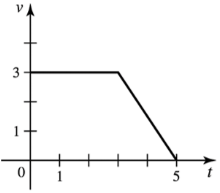
9–10. Velocity graphs The figures show velocity functions for motion along a line. Assume the motion begins with an initial position of s(0)=0. Determine the following.
a. The displacement between t=0 and t=5
Problem 6.7.39a
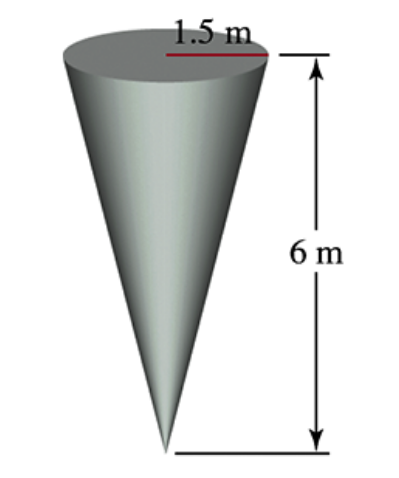
Emptying a conical tank A water tank is shaped like an inverted cone with height 6 m and base radius 1.5 m (see figure).
a. If the tank is full, how much work is required to pump the water to the level of the top of the tank and out of the tank?
Problem 6.5.24a
21–30. {Use of Tech} Arc length by calculator
a. Write and simplify the integral that gives the arc length of the following curves on the given interval.
y = x³/3, for −1≤x≤1
Problem 6.7.29a
Calculating work for different springs Calculate the work required to stretch the following springs 1.25 m from their equilibrium positions. Assume Hooke’s law is obeyed.
a. A spring that requires 100 J of work to be stretched 0.5 m from its equilibrium position
Problem 6.1.59a
Explain why or why not Determine whether the following statements are true and give an explanation or counterexample.
a. The distance traveled by an object moving along a line is the same as the displacement of the object.
Problem 6.5.23a
21–30. {Use of Tech} Arc length by calculator
a. Write and simplify the integral that gives the arc length of the following curves on the given interval.
y = ln x, for 1≤x≤4
Problem 6.6.23a
Determine whether the following statements are true and give an explanation or counterexample.
a. If the curve y=f(x) on the interval [a, b] is revolved about the y-axis, the area of the surface generated is ∫f(b)f(a) 2πf(y)√1+f′(y)^2 dy.
Problem 6.3.3a
Consider a solid whose base is the region in the first quadrant bounded by the curve y=√3−x and the line x=2, and whose cross sections through the solid perpendicular to the x-axis are squares.
a. Find an expression for the area A(x) of a cross section of the solid at a point x in [0, 2].
Problem 6.1.3a
Given the velocity function of an object moving along a line, explain how definite integrals can be used to find the displacement of the object.
Problem 6.5.27a
21–30. {Use of Tech} Arc length by calculator
a. Write and simplify the integral that gives the arc length of the following curves on the given interval.
y = cos 2x, for 0 ≤ x ≤ π
Problem 6.1.46a
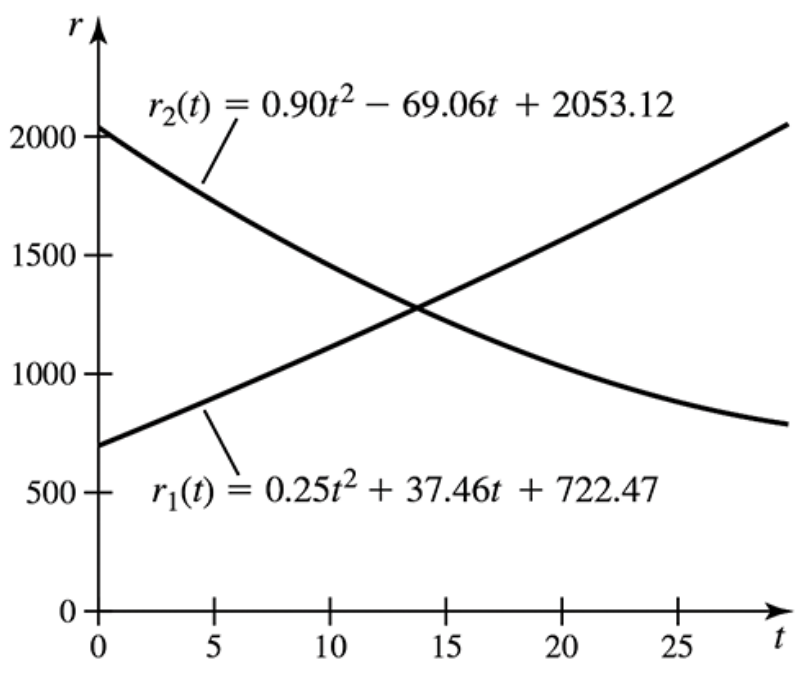
Flow rates in the Spokane River The daily discharge of the Spokane River as it flows through Spokane, Washington, in April and June is modeled by the functions
r1(t) = 0.25t²+37.46t+722.47 (April) and
r2(t) = 0.90t²−69.06t+2053.12 (June), where the discharge is measured in millions of cubic feet per day, and t=0 corresponds to the beginning of the first day of the month (see figure).
a. Determine the total amount of water that flows through Spokane in April (30 days).
Problem 6.4.8a
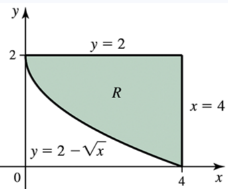
6–8. Let R be the region bounded by the curves y = 2−√x,y=2, and x=4 in the first quadrant.
Suppose the shell method is used to determine the volume of the solid generated by revolving R about the line x=4.
a. What is the radius of a cylindrical shell at a point x in [0, 4]?
Problem 6.1.23a
{Use of Tech} Oscillating motion A mass hanging from a spring is set in motion, and its ensuing velocity is given by v(t) = 2π cos πt, for t≥0. Assume the positive direction is upward and s(0)=0.
a. Determine the position function, for t≥0.
Problem 6.1.47a
Depletion of natural resources Suppose r(t) = r0e^−kt, with k>0, is the rate at which a nation extracts oil, where r0=10⁷ barrels/yr is the current rate of extraction. Suppose also that the estimate of the total oil reserve is 2×10⁹ barrels.
a. Find Q(t), the total amount of oil extracted by the nation after t years.
Problem 6.4.72a
Explain the steps required to find the length of a curve x = g(y) between y=c and y=d.