Back
Back
Problem 8.5.47
23-64. Integration Evaluate the following integrals.
47. ∫ (x³ - 10x² + 27x)/(x² - 10x + 25) dx
Problem 8.4.62
60–69. Completing the square Evaluate the following integrals.
62. ∫ du / (2u² - 12u + 36)
Problem 8.4.51
7-56. Trigonometric substitutions Evaluate the following integrals using trigonometric substitution.
51. ∫ x²/√(4 + x²) dx
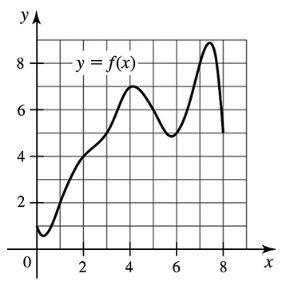
Problem 8.8.6
5-8. Compute the following estimates of ∫(0 to 8) f(x) dx using the graph in the figure.
6. T(4)
Problem 8.2.26
9–40. Integration by parts Evaluate the following integrals using integration by parts.
26. ∫ t³ sin(t) dt
Problem 8.6.59
7–84. Evaluate the following integrals.
59. ∫ 1/(x⁴ + x²) dx
Problem 8.9.53
7–58. Improper integrals Evaluate the following integrals or state that they diverge.
53. ∫ (from 0 to 1) ln x dx
Problem 8.1.7
7–64. Integration review Evaluate the following integrals.
7. ∫ dx / (3 - 5x)^4
Problem 8.9.1
What are the two general ways in which an improper integral may occur?
Problem 8.5.96
96. Challenge
Show that with the change of variables u = √tan x, the integral
∫ √tan x dx
can be converted to an integral amenable to partial fractions. Evaluate
∫[0 to π/4] √tan x dx.
Problem 8.4.33
7-56. Trigonometric substitutions Evaluate the following integrals using trigonometric substitution.
33. ∫ √(x² - 9)/x dx, x > 3
Problem 8.4.6
6. Using the trigonometric substitution x = 8 sec θ, where x ≥ 8 and 0 < θ ≤ π/2, express tan θ in terms of x.
Problem 8.2.20
9–40. Integration by parts Evaluate the following integrals using integration by parts.
20. ∫ sin⁻¹(x) dx
Problem 8.1.20
7–64. Integration review Evaluate the following integrals.
20. ∫ eˣ (1 + eˣ)⁹ (1 - eˣ) dx
Problem 8.9.66
65-76. Volumes Find the volume of the described solid of revolution or state that it does not exist.
66. The region bounded by f(x) = (x^2 + 1)^(-1/2) and the x-axis on the interval [2, ∞) is revolved about the x-axis.
Problem 8.3.5
5. What is a reduction formula?
Problem 8.6.94
92–98. Evaluate the following integrals.
94. ∫ (dt / (t³ + 1))
Problem 8.3.7
7. How would you evaluate ∫ tan¹⁰x sec²x dx?
Problem 8.1.57
7–64. Integration review Evaluate the following integrals.
57. ∫ dx / (x¹⸍² + x³⸍²)
Problem 8.9.98
95–98. {Use of Tech} Numerical methods Use numerical methods or a calculator to approximate the following integrals as closely as possible. The exact value of each integral is given.
98. ∫(from 0 to 1) (ln x)/(1+x) dx = -π²/12
Problem 8.8.18
15-18. {Use of Tech} Midpoint Rule approximations. Find the indicated Midpoint Rule approximations to the following integrals.
18. ∫(0 to 1) e⁻ˣ dx using n = 8 subintervals
Problem 8.7.31
7–40. Table look-up integrals Use a table of integrals to evaluate the following indefinite integrals. Some of the integrals require preliminary work, such as completing the square or changing variables, before they can be found in a table.
31. ∫ √(x² - 8x) dx, x > 8
Problem 8.6.45
7–84. Evaluate the following integrals.
45. ∫ from 0 to ln 2 [1 / (1 + eˣ)²] dx
Problem 8.4.71
{Use of Tech} Using the integral of sec³u By reduction formula 4 in Section 8.3,
∫sec³u du = 1/2 (sec u tan u + ln |sec u + tan u|) + C
Graph the following functions and find the area under the curve on the given interval.
f(x) = (9 - x²) ⁻², [0, 3/2]
Problem 8.9.106
102–106. Laplace transforms A powerful tool in solving problems in engineering and physics is the Laplace transform. Given a function f(t), the Laplace transform is a new function F(s) defined by F(s) = ∫[0 to ∞] e^(-st) f(t) dt, where we assume s is a positive real number. For example, to find the Laplace transform of f(t) = e^(-t), the following improper integral is evaluated using integration by parts:
F(s) = ∫[0 to ∞] e^(-st) e^(-t) dt = ∫[0 to ∞] e^(-(s+1)t) dt = 1/(s+1).
Verify the following Laplace transforms, where a is a real number.
106. f(t) = cos(at) → F(s) = s/(s² + a²)
Problem 8.9.59
59. Perpetual Annuity
Imagine that today you deposit $B in a savings account that earns interest at a rate of *p*% per year compounded continuously (see Section 7.2). The goal is to draw an income of $I per year from the account forever. The amount of money that must be deposited is:
B = I × ∫(from 0 to ∞) e^(-rt) dt
where r = p/100.
Suppose you find an account that earns 12% interest annually, and you wish to have an income from the account of $5000 per year. How much must you deposit today?
Problem 8.3.57
9–61. Trigonometric integrals Evaluate the following integrals.
57. ∫ from 0 to π of (1 - cos2x)³ᐟ² dx
Problem 8.6.53
7–84. Evaluate the following integrals.
53. ∫ eˣ cot³(eˣ) dx
Problem 8.6.19
7–84. Evaluate the following integrals.
19. ∫ from 0 to π/2 [sin⁷x] dx
Problem 8.3.51
9–61. Trigonometric integrals Evaluate the following integrals.
51. ∫ (csc²x + csc⁴x) dx