Ch. 18 - Nucleophilic Acyl Substitution I: Carboxylic Acids
Mullins - Organic Chemistry: A Learner Centered Approach 1st Edition
Mullins1st EditionOrganic Chemistry: A Learner Centered ApproachISBN: 9780137566471Not the one you use?Change textbook
Chapter 17, Problem 21

At the end of a reduction, there was found to be a small amount of unreacted amide along with the amine product dissolved in diethyl ether. How might you remove the amine from the ether?
Chemical reaction diagram showing the conversion of an amide to an amine using LiAlH4 in THF.

Verified step by step guidance
1
Step 1: Recognize that the amine product and unreacted amide are dissolved in diethyl ether, which is an organic solvent. To separate the amine, we can exploit its basicity and solubility properties.
Step 2: Prepare an aqueous acidic solution, such as dilute hydrochloric acid (HCl). The amine, being a basic compound, will react with the acid to form a water-soluble ammonium salt.
Step 3: Perform a liquid-liquid extraction. Add the aqueous acidic solution to the diethyl ether solution containing the amine and amide. Shake the mixture thoroughly to allow the amine to react with the acid and transfer into the aqueous phase as its ammonium salt.
Step 4: Separate the two layers using a separatory funnel. The aqueous layer will contain the ammonium salt of the amine, while the organic layer will retain the unreacted amide.
Step 5: To recover the amine, neutralize the aqueous layer with a base, such as sodium hydroxide (NaOH), to regenerate the free amine. Extract the amine back into a fresh portion of diethyl ether, if needed.

Verified video answer for a similar problem:

This video solution was recommended by our tutors as helpful for the problem above.
Was this helpful?

Key Concepts

Here are the essential concepts you must grasp in order to answer the question correctly.

Amine Solubility

Amines are organic compounds derived from ammonia by replacement of one or more hydrogen atoms with alkyl or aryl groups. They are generally soluble in polar solvents like water and can also dissolve in organic solvents such as diethyl ether. Understanding the solubility properties of amines is crucial for devising methods to separate them from other compounds in a mixture.
Recommended video:
Guided course
07:12
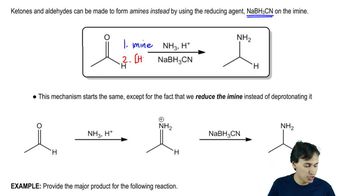
Reductive Amination

Extraction Techniques

Extraction is a separation technique used to isolate a desired substance from a mixture based on differences in solubility. In this context, liquid-liquid extraction can be employed to separate the amine from the ether solution by using a polar solvent that selectively dissolves the amine, allowing it to be removed from the non-polar ether phase.
Recommended video:
Guided course
05:41
Reason for Analytical Methods

Recrystallization

Recrystallization is a purification technique that involves dissolving a solid in a hot solvent and then allowing it to crystallize as it cools. This method can be useful for isolating pure amines from a mixture, as the desired amine can be selectively crystallized out of solution, leaving behind impurities and unreacted amides.