Ch. 23 - Benzene I: Aromatic Stability and Substitution Reactions
Mullins - Organic Chemistry: A Learner Centered Approach 1st Edition
Mullins1st EditionOrganic Chemistry: A Learner Centered ApproachISBN: 9780137566471Not the one you use?Change textbook
Chapter 22, Problem 59a

Predict the products of the following reactions.
(a) Chemical reaction diagram showing a brominated aniline and a stannylated compound with palladium catalyst for product prediction.

Verified step by step guidance
1
Identify the type of reaction: The reaction involves a bromopyridine and a stannane derivative in the presence of a palladium catalyst, indicating a Stille coupling reaction.
Understand the Stille coupling mechanism: This reaction involves the coupling of an organostannane with an organohalide, facilitated by a palladium catalyst, to form a new carbon-carbon bond.
Determine the coupling partners: In this reaction, the pyridine ring with the bromine atom is the organohalide, and the furan ring with the tin group is the organostannane.
Predict the product: The new carbon-carbon bond will form between the carbon atom of the pyridine ring that was bonded to the bromine and the carbon atom of the furan ring that was bonded to the tin group.
Consider the stereochemistry and regiochemistry: Since the reaction involves aromatic rings, the product will likely retain the aromaticity and the substitution pattern of the original reactants.

Verified video answer for a similar problem:

This video solution was recommended by our tutors as helpful for the problem above.
Video duration:
2m
Was this helpful?

Key Concepts

Here are the essential concepts you must grasp in order to answer the question correctly.

Stille Coupling Reaction

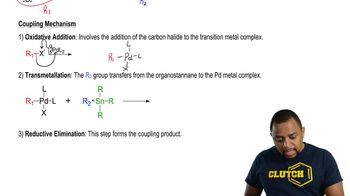
The Stille coupling reaction is a palladium-catalyzed cross-coupling reaction between an organotin compound and an organic halide or pseudohalide. It is used to form carbon-carbon bonds, often between aromatic rings. In this reaction, the organotin compound (SnBu3) reacts with the brominated aniline in the presence of a palladium catalyst to form a new C-C bond, resulting in the coupling of the two aromatic systems.
Recommended video:
Guided course
03:20
Stille Reaction

Role of Palladium Catalyst

Palladium catalysts, such as Pd(PPh3)4, are crucial in facilitating cross-coupling reactions like the Stille reaction. They work by forming a complex with the organic halide, which undergoes oxidative addition to the palladium center. This step is followed by transmetalation with the organotin compound and reductive elimination to form the desired C-C bond, regenerating the palladium catalyst for further reaction cycles.
Recommended video:
3:21
Catalytic Allylic Alkylation Concept 1

Organotin Compounds

Organotin compounds, such as the stannylated furan shown in the reaction, are key reagents in Stille coupling reactions. They contain a tin atom bonded to carbon groups, which can transfer an organic group to a palladium complex during the transmetalation step. This transfer is essential for forming the new carbon-carbon bond in the final product, making organotin compounds valuable in synthetic organic chemistry.
Recommended video:
Guided course
01:40
Defining meso compounds.