Ch. 5 - Chemical Reaction Analysis: Thermodynamics and Kinetics
Mullins - Organic Chemistry: A Learner Centered Approach 1st Edition
Mullins1st EditionOrganic Chemistry: A Learner Centered ApproachISBN: 9780137566471Not the one you use?Change textbook
Chapter 4, Problem 20a

Draw a reaction coordinate diagram for a one step reaction that has the following values of Ea and ∆H. (a) Ea = 9 kcal/mol ; ∆H° = + 4 kcal/mol

Verified step by step guidance
1
Step 1: Understand the reaction coordinate diagram. It is a graph that plots the energy of the system (y-axis) against the progress of the reaction (x-axis). Key features include the reactants, products, the transition state, and the activation energy (Eₐ).
Step 2: Identify the given values. The activation energy (Eₐ) is 9 kcal/mol, which represents the energy barrier between the reactants and the transition state. The enthalpy change (∆H°) is +4 kcal/mol, indicating that the reaction is endothermic (products are higher in energy than reactants).
Step 3: Begin sketching the diagram. Start by drawing a horizontal line to represent the energy level of the reactants. Then, draw a peak to represent the transition state, ensuring the height of the peak above the reactants corresponds to the activation energy (9 kcal/mol).
Step 4: Draw the energy level of the products. Since the reaction is endothermic (∆H° = +4 kcal/mol), the products should be at a higher energy level than the reactants. The difference in energy between the reactants and products should equal ∆H° (4 kcal/mol).
Step 5: Label the diagram. Clearly mark the reactants, products, transition state, activation energy (Eₐ), and enthalpy change (∆H°). Ensure the energy values are appropriately scaled and labeled on the y-axis for clarity.

Verified video answer for a similar problem:

This video solution was recommended by our tutors as helpful for the problem above.
Was this helpful?

Key Concepts

Here are the essential concepts you must grasp in order to answer the question correctly.

Activation Energy (Eₐ)

Activation energy (Eₐ) is the minimum energy required for a chemical reaction to occur. It represents the energy barrier that reactants must overcome to transform into products. In the context of a reaction coordinate diagram, Eₐ is depicted as the difference in energy between the reactants and the transition state, indicating how much energy must be supplied for the reaction to proceed.
Recommended video:
Guided course
06:07
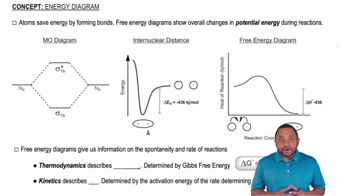
Introduction to free energy diagrams.

Enthalpy Change (∆H)

Enthalpy change (∆H) refers to the difference in energy between the products and the reactants in a chemical reaction. A positive ∆H indicates that the reaction is endothermic, meaning it absorbs heat from the surroundings. In a reaction coordinate diagram, ∆H is represented by the vertical distance between the reactants and products, providing insight into the energy dynamics of the reaction.
Recommended video:
Guided course
04:38
Calculating Enthalpies

Reaction Coordinate Diagram

A reaction coordinate diagram is a graphical representation that illustrates the energy changes during a chemical reaction as it progresses from reactants to products. The x-axis typically represents the reaction progress, while the y-axis shows the energy levels. Key features include the energy of the reactants, the transition state, and the products, allowing for visual analysis of activation energy and enthalpy changes.
Recommended video:
Guided course
05:02
Coordination Complexes