
Ch. 23 - Benzene I: Aromatic Stability and Substitution Reactions
Mullins - Organic Chemistry: A Learner Centered Approach 1st Edition
Mullins1st EditionOrganic Chemistry: A Learner Centered ApproachISBN: 9780137566471Not the one you use?Change textbook
Chapter 22, Problem 16b

(i) Classify the following molecules as aromatic, nonaromatic, or antiaromatic.
(ii) For the aromatic and antiaromatic molecules, solve for n in Hückel’s/Breslow’s rule. For the other molecules, explain which of the rules of aromaticity is being broken.
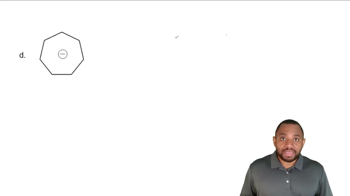
(b) Chemical structure of a pentagonal ring with a negative charge, used for classifying molecular aromaticity.

Verified step by step guidance
1
Identify the molecule: The structure shown is a cyclopentadienyl anion, which is a five-membered carbon ring with two double bonds and a negative charge.
Determine the number of π electrons: Each double bond contributes 2 π electrons, and the negative charge contributes 2 π electrons, totaling 6 π electrons.
Apply Hückel's rule: For a molecule to be aromatic, it must have (4n + 2) π electrons, where n is a non-negative integer. Set up the equation 4n + 2 = 6 and solve for n.
Solve for n: Subtract 2 from both sides to get 4n = 4, then divide by 4 to find n = 1.
Conclude the classification: Since the molecule has 6 π electrons and satisfies Hückel's rule with n = 1, it is classified as aromatic.

Verified video answer for a similar problem:

This video solution was recommended by our tutors as helpful for the problem above.
Was this helpful?

Key Concepts

Here are the essential concepts you must grasp in order to answer the question correctly.

Aromaticity

Aromaticity is a property of cyclic, planar structures with a ring of resonance bonds that leads to enhanced stability. For a molecule to be aromatic, it must follow Hückel's rule, which states that it should have (4n + 2) π electrons, where n is a non-negative integer. This rule helps determine the electron count that allows for delocalization and stability.
Recommended video:
Guided course
08:19
Intro to Aromaticity

Hückel's Rule

Hückel's rule is a criterion used to determine if a planar ring molecule is aromatic. According to this rule, a molecule is aromatic if it contains a total of (4n + 2) π electrons, where n is a non-negative integer. This electron count allows for the delocalization of electrons, contributing to the molecule's stability and unique chemical properties.
Recommended video:
Guided course
03:54
The 18 and 16 Electron Rule

Antiaromaticity

Antiaromaticity occurs in cyclic, planar molecules that have (4n) π electrons, leading to instability due to electron delocalization that does not favor resonance. Unlike aromatic compounds, antiaromatic compounds are less stable than their non-cyclic or non-planar counterparts. Identifying antiaromaticity involves checking the electron count and ensuring the molecule is planar and cyclic.
Recommended video:
Guided course
02:58
Determine the aromaticity