The sulfur and oxygen in methanethiol and methanol are both sp3 hybridized. Why is the S―H bond longer than the O―H bond?
Ch. 2 - General Chemistry Translated: Finding the Electrons

Mullins1st EditionOrganic Chemistry: A Learner Centered ApproachISBN: 9780137566471Not the one you use?Change textbook
All textbooks
Mullins 1st Edition
Ch. 2 - General Chemistry Translated: Finding the Electrons
Problem 44
Mullins 1st Edition
Ch. 2 - General Chemistry Translated: Finding the Electrons
Problem 44Chapter 1, Problem 44
A molecular orbital diagram is shown for the C―Cl bond in chloromethane. If two more electrons were added to chloromethane, where would the electrons go?
<IMAGE>
Verified step by step guidance1
Step 1: Analyze the molecular orbital diagram provided. The diagram shows the bonding (σ) and antibonding (σ*) molecular orbitals for the C-Cl bond in chloromethane. The bonding orbital (σ) is lower in energy and fully occupied with two electrons, while the antibonding orbital (σ*) is higher in energy and currently unoccupied.
Step 2: Recall the principle of electron filling in molecular orbitals. Electrons fill the lowest available energy orbitals first, following the Aufbau principle. If additional electrons are added to the molecule, they will occupy the next available orbital with the lowest energy.
Step 3: Determine the next available orbital. Since the bonding orbital (σ) is already fully occupied, the next available orbital is the antibonding orbital (σ*), which is higher in energy.
Step 4: Consider the implications of adding electrons to the antibonding orbital. Electrons in antibonding orbitals weaken the bond between the atoms because they counteract the stabilizing effect of electrons in the bonding orbital.
Step 5: Conclude that if two more electrons were added to chloromethane, they would occupy the antibonding orbital (σ*), potentially destabilizing the C-Cl bond.

Verified video answer for a similar problem:
This video solution was recommended by our tutors as helpful for the problem above.
Video duration:
55sWas this helpful?
Key Concepts
Here are the essential concepts you must grasp in order to answer the question correctly.
Molecular Orbital Theory
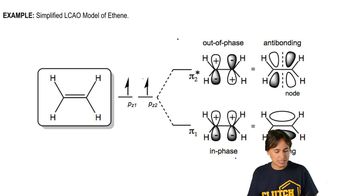
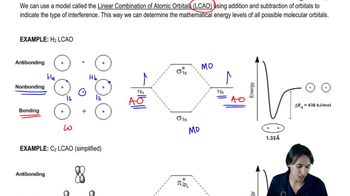
Molecular Orbital Theory describes how atomic orbitals combine to form molecular orbitals, which can be occupied by electrons. In this theory, electrons are delocalized over the entire molecule rather than being localized between individual atoms. The energy levels of these molecular orbitals determine the stability and reactivity of the molecule, with bonding orbitals being lower in energy and antibonding orbitals being higher.
Recommended video:
Guided course
Review of Molecular Orbitals
Electron Configuration in Molecular Orbitals
The electron configuration in molecular orbitals indicates how electrons are distributed among the available molecular orbitals. Electrons fill the lowest energy orbitals first, following the Pauli exclusion principle and Hund's rule. In the case of chloromethane, the molecular orbital diagram shows the placement of electrons in bonding (σ) and antibonding (σ*) orbitals, which is crucial for predicting how additional electrons would be accommodated.
Recommended video:
Guided course
The Electron Configuration
Bonding and Antibonding Orbitals
Bonding orbitals are formed when atomic orbitals combine constructively, leading to increased electron density between the nuclei, which stabilizes the bond. Antibonding orbitals, indicated by an asterisk (σ*), result from destructive interference and have higher energy, leading to destabilization. When considering the addition of electrons to chloromethane, it is essential to determine whether they will occupy bonding or antibonding orbitals based on their energy levels.
Recommended video:
Guided course
What’s the difference between atomic and molecular orbitals?
Related Practice
Textbook Question
1685
views
Textbook Question
Each pair of structures represents two valid resonance structures. Use the arrow-pushing formalism to justify the formation of the one on the left from the one on the right.
(b)
1121
views
Textbook Question
Rank the following molecules by the length of the indicated bond from shortest to longest.
(a)
(b)
(c)
1587
views
Textbook Question
How might electrons be excited from π to π* based on the molecular orbital diagram shown? [This will be relevant in Chapter 21.]
<IMAGE>
953
views
Textbook Question
Each pair of structures represents two valid resonance structures. Use the arrow-pushing formalism to justify the formation of the one on the left from the one on the right.
(a)
1244
views
Textbook Question
Use hybrid orbitals to draw the following molecules.
(d)
1451
views