Ch. 8 - Alkenes I: Properties and Electrophilic Additions
Mullins - Organic Chemistry: A Learner Centered Approach 1st Edition
Mullins1st EditionOrganic Chemistry: A Learner Centered ApproachISBN: 9780137566471Not the one you use?Change textbook
Chapter 7, Problem 45f

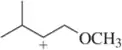
Which of the following carbocations would you expect to rearrange? If you expect rearrangement, draw the carbocation you expect to form and the mechanism by which it will form.
(f) Carbocation structure with a positive charge on a carbon atom, connected to an OCH3 group.

Verified step by step guidance
1
Identify the structure of the given carbocation. Determine whether it is a primary, secondary, or tertiary carbocation, as this will influence its stability and likelihood of rearrangement.
Recall that carbocations rearrange to form more stable carbocations. Stability increases in the order: primary < secondary < tertiary < allylic < benzylic. Look for opportunities for hydride shifts or alkyl shifts that could lead to a more stable carbocation.
Examine the neighboring carbon atoms (adjacent to the carbocation). Check if a hydride (H⁻) or an alkyl group can migrate to the carbocation center to form a more stable carbocation. This is known as a 1,2-hydride shift or 1,2-alkyl shift.
Draw the structure of the rearranged carbocation. Ensure that the rearrangement follows the rules of organic chemistry, such as maintaining the correct number of bonds and observing the octet rule where applicable.
Illustrate the mechanism of the rearrangement. Use curved arrows to show the movement of electrons during the hydride or alkyl shift. Clearly label the starting carbocation, the intermediate steps (if any), and the final rearranged carbocation.

Verified video answer for a similar problem:

This video solution was recommended by our tutors as helpful for the problem above.
Video duration:
5m
Was this helpful?

Key Concepts

Here are the essential concepts you must grasp in order to answer the question correctly.

Carbocation Stability

Carbocations are positively charged carbon species that can undergo rearrangement to form more stable structures. The stability of a carbocation is influenced by factors such as the degree of substitution (primary, secondary, tertiary) and resonance. Tertiary carbocations are the most stable due to hyperconjugation and inductive effects from surrounding alkyl groups, while primary carbocations are the least stable.
Recommended video:
Guided course
05:58
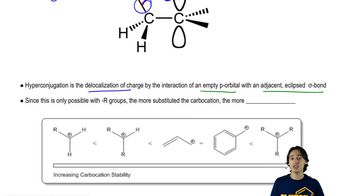
Determining Carbocation Stability

Carbocation Rearrangement Mechanisms

Carbocation rearrangement typically occurs through two main mechanisms: hydride shifts and alkyl shifts. In a hydride shift, a hydrogen atom from an adjacent carbon moves to the positively charged carbon, stabilizing the carbocation. An alkyl shift involves the movement of an alkyl group to the carbocation center, also leading to a more stable carbocation. Understanding these mechanisms is crucial for predicting the products of reactions involving carbocations.
Recommended video:
Guided course
07:21
Any Carbocation

Reaction Pathways and Energy Considerations

The likelihood of carbocation rearrangement is influenced by the energy of the transition states and the stability of the resulting carbocations. A reaction pathway that leads to a lower energy product is favored. When evaluating potential rearrangements, it is essential to consider the energy barriers and the stability of both the starting carbocation and the rearranged product to determine if rearrangement will occur.
Recommended video:
1:08
Energy Production In Biochemical Pathways Example 1