Textbook Question
For each molecule, draw the Newman projection you would observe if you looked down the Ca - Cb bond in the direction indicated.
(d) <IMAGE>
1194
views

 Mullins 1st EditionCh. 3 - Alkanes and Cycloalkanes: Properties and Conformational AnalysisProblem 19c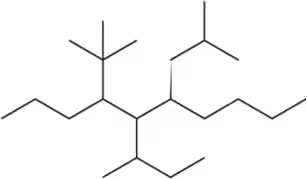
 Verified step by step guidance
 02:47
02:47
 03:07
03:07 01:20
01:20For each molecule, draw the Newman projection you would observe if you looked down the Ca - Cb bond in the direction indicated.
(d) <IMAGE>
When we begin studying reactive intermediates, the designation of substitution will be especially important. Label the following carbocations as 1° , 2°, 3°, or 4° or based on the carbon bearing the positive charge.
(b)
When we begin studying functional groups, the designation of substitution will be especially important. Label the following bromoalkanes as 1° , 2°, 3°, or 4° based on the carbon to which the bromine is attached.
(b)
When we begin studying reactive intermediates, the designation of substitution will be especially important. Label the following carbocations as 1° , 2°, 3°, or 4° or based on the carbon bearing the positive charge.
(c)
Using the Newman projections shown, draw each molecule in its line-angle drawing with all hydrogens and substituents shown. [Carbon b is behind carbon a in these structures.] Wedges and dashes should be used to indicate whether a substituent is coming out of, or going into, the plane of the page.
(b)
In Chapter 8, we study the chemistry of alkenes, like ethene. In contrast to ethane, there is no free rotation around the C = C double bond of ethene. Explain this in the context of the molecular orbital picture of ethene.