
Ch. 23 - Benzene I: Aromatic Stability and Substitution Reactions
Mullins - Organic Chemistry: A Learner Centered Approach 1st Edition
Mullins1st EditionOrganic Chemistry: A Learner Centered ApproachISBN: 9780137566471Not the one you use?Change textbook
Chapter 22, Problem 21

Draw a Frost circle for the cyclopropenyl anion and compare it to the Frost circle for the cyclopropenyl cation. What has changed?
Frost circle diagrams comparing the cyclopropenyl anion and cation, highlighting structural differences.

Verified step by step guidance
1
To draw a Frost circle for the cyclopropenyl anion, start by drawing a circle with a triangle inscribed inside it, where each vertex of the triangle represents a carbon atom in the cyclopropenyl anion.
Position the triangle such that one of its vertices points downward, touching the bottom of the circle. This represents the energy levels of the molecular orbitals.
For the cyclopropenyl anion, which has 4 π electrons, fill the molecular orbitals starting from the lowest energy level. Each line in the Frost circle represents a molecular orbital, and each orbital can hold 2 electrons.
Now, compare this to the Frost circle for the cyclopropenyl cation, which has 2 π electrons. The cation's Frost circle will have the same triangular arrangement, but only the lowest energy level will be filled with 2 electrons.
The key difference between the anion and cation Frost circles is the number of electrons and the resulting filling of the molecular orbitals. The anion has an extra electron, which fills the next available orbital, altering the electronic configuration and stability of the molecule.

Verified video answer for a similar problem:

This video solution was recommended by our tutors as helpful for the problem above.
Video duration:
7m
Was this helpful?

Key Concepts

Here are the essential concepts you must grasp in order to answer the question correctly.

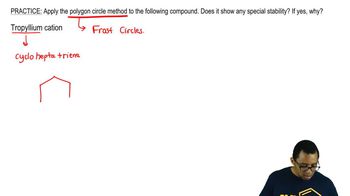
Frost Circle Method

The Frost Circle method is a graphical tool used to predict the relative energies of molecular orbitals in cyclic conjugated systems. By inscribing a polygon representing the molecule inside a circle, the vertices indicate the energy levels of the orbitals. This method helps visualize the stability and electronic configuration of molecules like cyclopropenyl anion and cation.
Recommended video:
Guided course
02:56
Inscribed Polygon Method

Cyclopropenyl Anion and Cation

Cyclopropenyl anion and cation are three-membered ring structures with differing charges. The anion has an extra electron, resulting in a negative charge, while the cation lacks an electron, giving it a positive charge. These charge differences affect the electronic structure and stability, which can be analyzed using Frost circles to compare their molecular orbital energies.
Recommended video:
1:06
Anionic Polymerization Concept 4

Molecular Orbital Theory

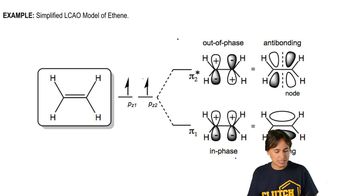
Molecular Orbital Theory explains the behavior of electrons in molecules by describing them as delocalized orbitals spread over the entire molecule. It helps predict the stability and reactivity of molecules by analyzing the filling of these orbitals. In the context of cyclopropenyl anion and cation, this theory aids in understanding how the addition or removal of electrons affects their electronic configuration and stability.
Recommended video:
Guided course
08:41
Review of Molecular Orbitals