Ch. 13 - Alcohols, Ethers and Related Compounds: Substitution and Elimination
Mullins - Organic Chemistry: A Learner Centered Approach 1st Edition
Mullins1st EditionOrganic Chemistry: A Learner Centered ApproachISBN: 9780137566471Not the one you use?Change textbook
Chapter 12, Problem 84b

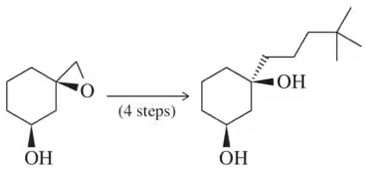
Show how a protecting group might be used to make these reactions successful.
(b)

Verified step by step guidance
1
Identify the functional groups in the starting material and the target molecule. The starting material has an epoxide and an alcohol group, while the target molecule has two alcohol groups and a new alkyl group.
Consider the reactivity of the epoxide and alcohol groups. Epoxides are highly reactive and can undergo ring-opening reactions, which might interfere with the desired transformation if not properly controlled.
Select an appropriate protecting group for the alcohol. Common protecting groups for alcohols include silyl ethers like TBS (tert-butyldimethylsilyl) or TBDMS (tert-butyldimethylsilyl). These groups can protect the alcohol from unwanted reactions during the transformation.
Apply the protecting group to the alcohol in the starting material. This step involves converting the alcohol to a silyl ether, which will prevent it from reacting during the subsequent steps.
Perform the desired transformation on the epoxide, such as a ring-opening reaction with a nucleophile to introduce the new alkyl group. After the transformation, remove the protecting group to regenerate the alcohol functionality in the target molecule.

Verified video answer for a similar problem:

This video solution was recommended by our tutors as helpful for the problem above.
Was this helpful?

Key Concepts

Here are the essential concepts you must grasp in order to answer the question correctly.

Protecting Groups

Protecting groups are chemical moieties that temporarily mask reactive functional groups in a molecule, allowing for selective reactions to occur without interference. They are crucial in multi-step organic synthesis, as they enable chemists to control the reactivity of specific sites, ensuring that desired transformations can take place without unwanted side reactions.
Recommended video:
Guided course
02:44
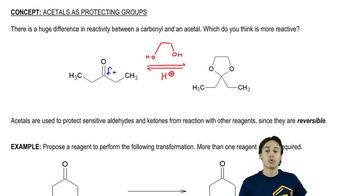
Protecting Groups

Reactivity of Functional Groups

Different functional groups exhibit varying reactivities under specific conditions. Understanding the reactivity of these groups is essential for designing synthetic pathways, as it helps predict which reactions can occur and how protecting groups can be strategically employed to shield certain functionalities from reaction conditions that would otherwise lead to undesired outcomes.
Recommended video:
Guided course
02:36
Identifying Functional Groups

Deprotection

Deprotection is the process of removing a protecting group after the desired reaction has been completed. This step is critical in synthetic chemistry, as it restores the original functionality of the molecule, allowing for further reactions or the final product to be obtained. The choice of protecting group often depends on the conditions required for deprotection, which must be compatible with the remaining functional groups in the molecule.
Recommended video:
Guided course
05:49
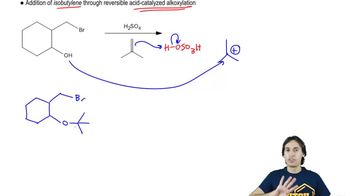
Mechanism of t-Butyl Ether Protecting Groups.