Ch. 15 - Structural Identification II: Nuclear Magnetic Resonance Spectroscopy
Mullins - Organic Chemistry: A Learner Centered Approach 1st Edition
Mullins1st EditionOrganic Chemistry: A Learner Centered ApproachISBN: 9780137566471Not the one you use?Change textbook
Chapter 14, Problem 8

Draw the peak that would correspond to the hydrogens at C₃ in the molecule shown. Be sure to indicate the integration and place it at an appropriate chemical shift.
Molecule structure with numbered carbon atoms 1 to 5, showing an ester functional group between C3 and C4.

Verified step by step guidance
1
Identify the molecule structure and locate the C₃ position. Determine the type of hydrogens attached to C₃, considering the molecular environment.
Consider the electronic environment around C₃. Evaluate factors such as electronegativity of nearby atoms and resonance effects that might influence the chemical shift of the hydrogens at C₃.
Estimate the chemical shift range for the hydrogens at C₃ using typical values for similar environments. Use reference tables or literature values for guidance.
Determine the integration of the peak. Count the number of hydrogens attached to C₃ and use this to set the relative integration of the peak in the NMR spectrum.
Draw the peak on the NMR spectrum at the estimated chemical shift range. Label the peak with the integration value and ensure it reflects the number of hydrogens at C₃.

Verified video answer for a similar problem:

This video solution was recommended by our tutors as helpful for the problem above.
Was this helpful?

Key Concepts

Here are the essential concepts you must grasp in order to answer the question correctly.

Chemical Shift

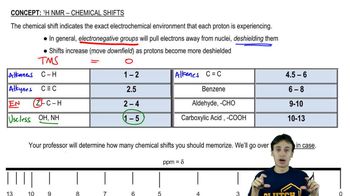
Chemical shift refers to the position on the NMR spectrum where a particular type of hydrogen atom resonates. It is influenced by the electronic environment surrounding the hydrogen, with deshielded hydrogens appearing at higher ppm values. Understanding chemical shift is crucial for predicting where the hydrogens at C₃ will appear on the spectrum.
Recommended video:
Guided course
11:44
1H NMR Chemical Shifts

Integration in NMR

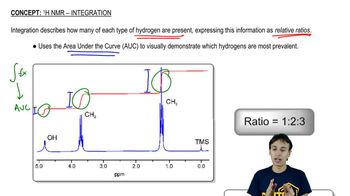
Integration in NMR spectroscopy indicates the relative number of hydrogens contributing to a particular signal. It is represented by the area under the peak and helps in determining the number of equivalent hydrogens at a specific location in the molecule. Proper integration is essential for accurately representing the hydrogens at C₃.
Recommended video:
Guided course
06:46
1H NMR Integration

NMR Peak Shape

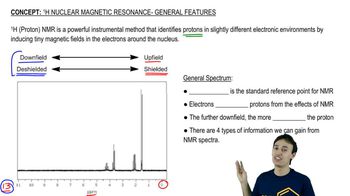
The shape of an NMR peak can provide information about the coupling between hydrogens. Singlets, doublets, triplets, etc., arise from the splitting patterns due to neighboring hydrogens. Recognizing the peak shape helps in understanding the local environment of the hydrogens at C₃ and their interactions with adjacent atoms.
Recommended video:
Guided course
10:06
General NMR Features