Ch. 17 - Carbonyl Addition Reactions: Aldehydes and Ketones
Mullins - Organic Chemistry: A Learner Centered Approach 1st Edition
Mullins1st EditionOrganic Chemistry: A Learner Centered ApproachISBN: 9780137566471Not the one you use?Change textbook
Chapter 16, Problem 70

When a ketone is dissolved in 18O-labeled water, the 18O label is incorporated into the ketone. Suggest a mechanism that explains this observation.
Chemical reaction showing a ketone reacting with 18O-labeled water, incorporating the label into the ketone structure.

Verified step by step guidance
1
Identify the ketone structure and the labeled water. The ketone has a carbonyl group (C=O), and the labeled water is H2^18O, where the oxygen is the isotope ^18O.
Understand that the mechanism involves the exchange of the oxygen atom in the carbonyl group with the labeled oxygen from water. This typically occurs through a reversible reaction.
Propose the first step of the mechanism: the nucleophilic attack of the water molecule on the electrophilic carbon of the carbonyl group. This forms a tetrahedral intermediate.
In the next step, the intermediate collapses, leading to the expulsion of the original oxygen atom as a hydroxide ion (OH^-), and the incorporation of the ^18O from the water into the carbonyl group.
Finally, the hydroxide ion can abstract a proton from the newly formed hydroxyl group, regenerating the ketone structure with the ^18O incorporated into the carbonyl group, completing the exchange process.

Verified video answer for a similar problem:

This video solution was recommended by our tutors as helpful for the problem above.
Video duration:
2m
Was this helpful?

Key Concepts

Here are the essential concepts you must grasp in order to answer the question correctly.

Ketone Structure and Reactivity

Ketones are carbonyl compounds characterized by a carbon atom double-bonded to an oxygen atom (C=O) with two alkyl or aryl groups attached. The carbonyl carbon is electrophilic, making it susceptible to nucleophilic attack. This reactivity is crucial for understanding how ketones can undergo reactions that incorporate isotopic labels, such as the exchange of oxygen atoms in the presence of labeled water.
Recommended video:
Guided course
02:27
Name the ketone

Isotopic Labeling

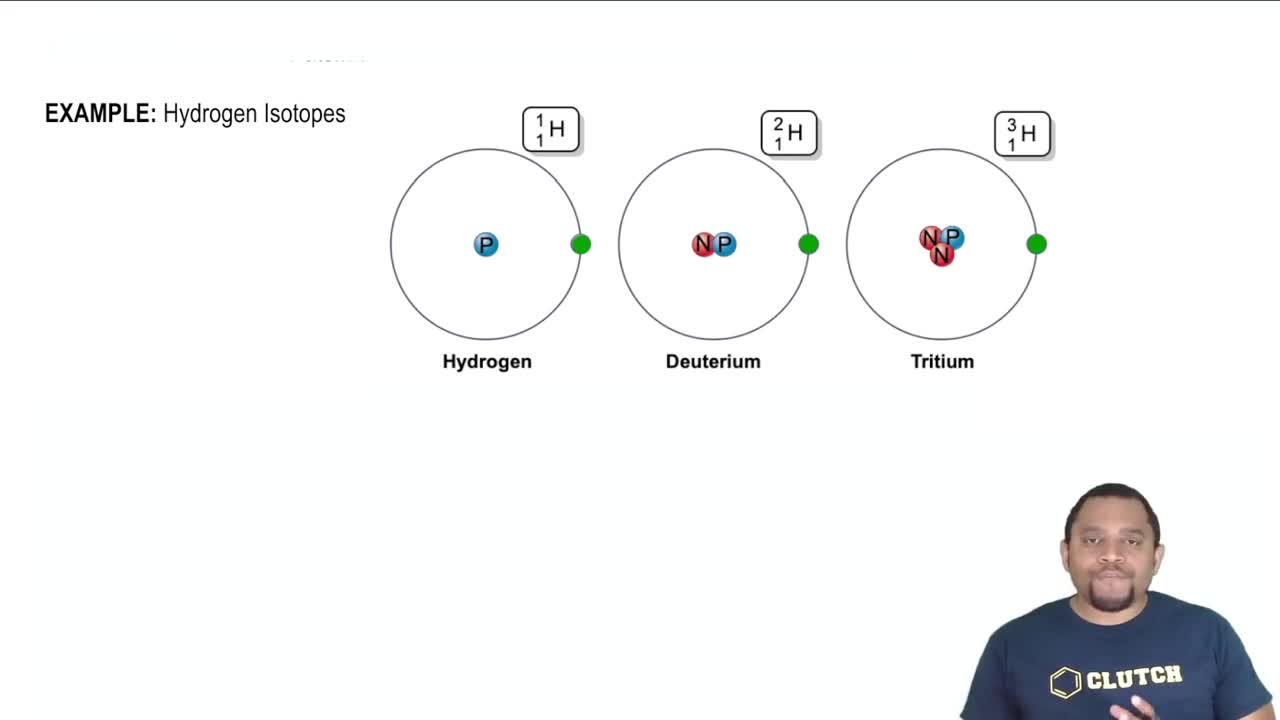
Isotopic labeling involves replacing an atom in a molecule with its isotope, such as replacing regular oxygen (16O) with its heavier isotope (18O). This technique is used to trace the path of atoms through a chemical reaction. In the context of the question, 18O-labeled water is used to track the incorporation of the oxygen isotope into the ketone, providing insights into the reaction mechanism.
Recommended video:
Guided course
03:06
Understanding the hydrogen isotopes.

Nucleophilic Addition-Elimination Mechanism

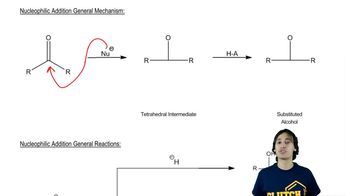
The nucleophilic addition-elimination mechanism involves a nucleophile attacking an electrophilic carbon, forming a tetrahedral intermediate, followed by the elimination of a leaving group. In the case of ketones reacting with water, the water molecule acts as a nucleophile, attacking the carbonyl carbon, leading to the incorporation of the 18O label into the ketone through a reversible hydration-dehydration process.
Recommended video:
Guided course
08:27
Nucleophilic Addition