
Ch. 10 - Alkynes: Electrophilic Addition and Redox Reactions
Mullins - Organic Chemistry: A Learner Centered Approach 1st Edition
Mullins1st EditionOrganic Chemistry: A Learner Centered ApproachISBN: 9780137566471Not the one you use?Change textbook
Chapter 9, Problem 41b

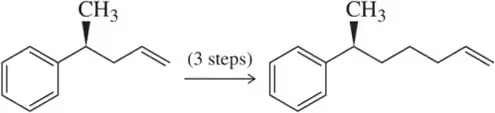
Beginning with the molecules on the left of each chemical equation, synthesize the molecules shown. While there can be multiple ways of doing each synthesis, the minimum number of steps necessary is indicated over each reaction arrow.
(b) Chemical reaction diagram showing synthesis from one molecule to another in three steps, with structures labeled.

Verified step by step guidance
1
Step 1: Analyze the starting molecule and the target molecule. Identify the functional groups present in both and determine the changes required to convert the starting molecule into the target molecule.
Step 2: Determine the minimum number of steps indicated over the reaction arrow. This will guide you to find the most efficient pathway for the synthesis.
Step 3: Break down the synthesis into individual reactions. For each step, identify the reagents and conditions necessary to achieve the desired transformation. For example, if a hydroxyl group needs to be converted into a ketone, consider using an oxidizing agent like PCC (Pyridinium Chlorochromate).
Step 4: Ensure that each intermediate formed in the synthesis is stable and can be isolated or directly used in the next step. Verify that the reaction conditions do not interfere with other functional groups present in the molecule.
Step 5: Write out the complete reaction sequence, including all reagents, conditions, and intermediates, ensuring that the synthesis adheres to the minimum number of steps indicated.

Verified video answer for a similar problem:

This video solution was recommended by our tutors as helpful for the problem above.
Video duration:
2m
Was this helpful?

Key Concepts

Here are the essential concepts you must grasp in order to answer the question correctly.

Chemical Synthesis

Chemical synthesis refers to the process of creating complex chemical compounds from simpler ones through a series of chemical reactions. Understanding the principles of synthesis is crucial for determining the most efficient pathway to produce a desired molecule, often involving the selection of appropriate reagents and reaction conditions.
Recommended video:
3:11
Chemical Reactions of Phosphate Anhydrides Concept 1

Reaction Mechanisms

A reaction mechanism is a detailed description of the step-by-step process by which reactants are converted into products. It includes the identification of intermediates and transition states, which helps in predicting the outcome of reactions and understanding how to manipulate conditions to achieve the desired synthesis.
Recommended video:
Guided course
02:16
Heck Reaction Mechanism

Stoichiometry

Stoichiometry involves the calculation of reactants and products in chemical reactions based on the conservation of mass. It is essential for determining the quantities of substances needed for a synthesis and ensuring that reactions proceed efficiently without excess waste, which is particularly important in multi-step syntheses.
Recommended video:
Guided course
02:08
Organic molecules in your everyday life.