Ch. 10 - Alkynes: Electrophilic Addition and Redox Reactions
Mullins - Organic Chemistry: A Learner Centered Approach 1st Edition
Mullins1st EditionOrganic Chemistry: A Learner Centered ApproachISBN: 9780137566471Not the one you use?Change textbook
Chapter 9, Problem 9a

Draw the structures that correspond to the following IUPAC names.
(a) (R)-4-isopropyl-6-methylhept-2-yne

Verified step by step guidance
1
Step 1: Break down the IUPAC name into its components. The name '(R)-4-isopropyl-6-methylhept-2-yne' indicates: (a) 'hept' as the parent chain, meaning it has 7 carbon atoms, (b) '2-yne' indicates a triple bond starting at carbon 2, (c) substituents '4-isopropyl' and '6-methyl' are attached to the parent chain, and (d) the '(R)' configuration specifies the stereochemistry at carbon 4.
Step 2: Draw the parent chain. Start with a straight chain of 7 carbon atoms (heptane). Add a triple bond between carbons 2 and 3 to represent the '2-yne' functional group.
Step 3: Add the substituents. Attach an isopropyl group (a branched group with the structure CH(CH3)2) to carbon 4 and a methyl group (CH3) to carbon 6 of the parent chain.
Step 4: Assign the stereochemistry. The '(R)' configuration at carbon 4 means you need to prioritize the groups attached to this carbon based on the Cahn-Ingold-Prelog rules. Arrange the groups in 3D space and ensure the configuration matches the '(R)' designation.
Step 5: Verify the structure. Double-check that the parent chain, triple bond, substituents, and stereochemistry are all correctly represented in the final structure.

Verified video answer for a similar problem:

This video solution was recommended by our tutors as helpful for the problem above.
Video duration:
3m
Was this helpful?

Key Concepts

Here are the essential concepts you must grasp in order to answer the question correctly.

IUPAC Nomenclature

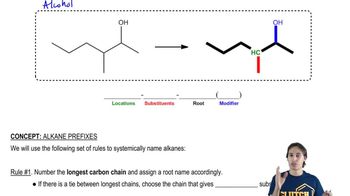
IUPAC nomenclature is a systematic method for naming organic chemical compounds. It provides a set of rules to derive the name from the structure, ensuring that each compound has a unique and descriptive name. Understanding the nomenclature rules, such as identifying the longest carbon chain and substituents, is essential for accurately interpreting and drawing chemical structures.
Recommended video:
Guided course
03:43
The different parts of an IUPAC name

Stereochemistry

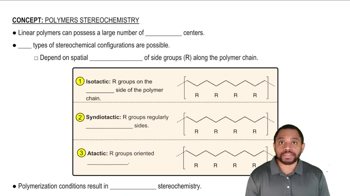
Stereochemistry refers to the study of the spatial arrangement of atoms in molecules and how this affects their chemical behavior. The designation of (R) or (S) in a compound indicates its specific three-dimensional configuration around a chiral center. Recognizing stereochemical descriptors is crucial for drawing the correct structure, especially when dealing with chiral compounds.
Recommended video:
1:38
Polymer Stereochemistry Concept 1

Alkynes

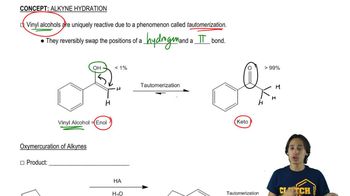
Alkynes are a class of hydrocarbons characterized by at least one carbon-carbon triple bond. They are unsaturated compounds and can exhibit unique reactivity due to the presence of this triple bond. Understanding the structure and properties of alkynes, including how to represent them in structural formulas, is vital for accurately drawing compounds like (R)-4-isopropyl-6-methylhept-2-yne.
Recommended video:
Guided course
09:11
Alkyne Hydration