
Ch. 10 - Alkynes: Electrophilic Addition and Redox Reactions
Mullins - Organic Chemistry: A Learner Centered Approach 1st Edition
Mullins1st EditionOrganic Chemistry: A Learner Centered ApproachISBN: 9780137566471Not the one you use?Change textbook
Chapter 9, Problem 55

The synthesis of five-membered lactones (cyclic esters) has been accomplished using the electrophilic addition of I―Cl to an alkyne. Suggest a mechanism for this cyclization reaction. (Structure modification of Yao, T.; Larock, R.C. J. Org. Chem. 2005, 70, 1432–1437.)

Verified step by step guidance
1
Step 1: Analyze the starting material and identify the functional groups. The molecule contains an alkyne (≡C), a hydroxyl group (-OH), a ketone (C=O), and a trimethylsilyl group (SiMe₃). The reaction involves electrophilic addition of I-Cl to the alkyne.
Step 2: Recognize the role of I-Cl as an electrophile. The iodine atom (I) is less electronegative and will act as the electrophilic center, while chlorine (Cl) is more electronegative and will act as the nucleophilic center.
Step 3: Propose the first step of the mechanism. The alkyne undergoes electrophilic attack by the iodine atom, forming a cyclic iodonium ion intermediate. This step is facilitated by the electron-rich π-bond of the alkyne.
Step 4: Suggest the nucleophilic attack by the hydroxyl group (-OH). The hydroxyl group attacks the iodonium ion intermediate, leading to the formation of a five-membered lactone ring. This step involves intramolecular cyclization.
Step 5: Finalize the mechanism by considering the addition of chlorine (Cl) to the remaining carbon of the alkyne. The chlorine atom adds to the carbon adjacent to the iodine, completing the electrophilic addition and forming the final product with the lactone ring and halogen substituents.

Verified video answer for a similar problem:

This video solution was recommended by our tutors as helpful for the problem above.
Video duration:
6m
Was this helpful?

Key Concepts

Here are the essential concepts you must grasp in order to answer the question correctly.

Electrophilic Addition

Electrophilic addition is a fundamental reaction mechanism in organic chemistry where an electrophile reacts with a nucleophile, resulting in the formation of a new bond. In this context, iodine (I) acts as the electrophile, adding to the alkyne, which is a nucleophilic site due to its electron-rich triple bond. This step is crucial for initiating the cyclization process leading to the formation of the five-membered lactone.
Recommended video:
Guided course
09:23
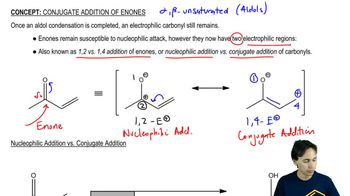
1,2 vs 1,4 Addition

Cyclization Reactions

Cyclization reactions involve the formation of a cyclic compound from a linear precursor. In this case, the electrophilic addition of I-Cl to the alkyne facilitates the formation of a cyclic ester (lactone) by creating a new bond that closes the ring. Understanding the conditions and mechanisms that favor cyclization is essential for predicting the outcome of such reactions in organic synthesis.
Recommended video:
Guided course
01:33
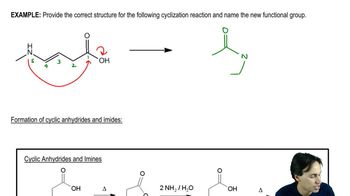
Cyclization Reaction

Lactone Formation

Lactones are cyclic esters formed from the reaction of a hydroxy acid or a carboxylic acid with an alcohol, resulting in the loss of water. The synthesis of five-membered lactones, as described in the question, typically involves intramolecular reactions where the hydroxyl group attacks the carbonyl carbon, leading to ring closure. Recognizing the structural features that promote lactone formation is vital for understanding the overall reaction mechanism.
Recommended video:
Guided course
05:19
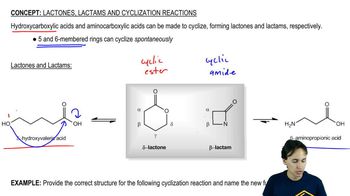
Lactones and Lactams
Related Practice
Textbook Question

The addition of H―X to alkynes has been shown to occur predominately via anti addition:

Two chemists disagreed on whether or not anti addition would happen on terminal alkynes as well. Suggest an experiment through which you could resolve this dispute.

1323
views
Textbook Question

In Section 10.8.1, you learned that alkenes react more quickly with electrophiles than do the corresponding alkynes (kalkene/kalkyne > 1). Explain why there is a greater disparity in the alkene versus alkyne reactivity in the addition of HBr as compared to the addition of Br2 [The rate data are not real, but are meant to illustrate a real trend.]

977
views
Textbook Question

In 1973, Caine and Tuller reported a synthesis of racemic oplapanone, a sesquiterpene isolated from Oplopanax japonicus (a deciduous shrub) involving a reaction we learned in this chapter. Predict the product of the reaction shown. (Caine, D.; Tuller, F. N. J. Org. Chem. 1973, 38, 3663.)

997
views
Textbook Question

A chemist attempted to do the following acetylide alkylation reaction but was unsuccessful in several attempts, producing only the original starting materials in each case. Explain why the reaction didn't work.

952
views
Textbook Question

When alkynes are treated with water and bromine a bromoketone is produced. Provide a plausible arrow-pushing mechanism that accounts for the formation of this product.

1431
views
Textbook Question

Trans addition is heavily favored for the addition of Br₂ and Cl₂ to alkynes. With chlorination, however, more of the syn addition product is formed. Rationalize this fact in light of your answer to Assessments 10.50 and 10.51.

1437
views