Ch. 10 - Alkynes: Electrophilic Addition and Redox Reactions
Mullins - Organic Chemistry: A Learner Centered Approach 1st Edition
Mullins1st EditionOrganic Chemistry: A Learner Centered ApproachISBN: 9780137566471Not the one you use?Change textbook
Chapter 9, Problem 45d

Show the products of the following acetylide alkylation reactions. [Make sure your product has the correct number of carbons.]
(d)

Verified step by step guidance
1
Step 1: Recognize the reactants. The starting material is acetylene (H≡H), and the reagents are sodium amide (NaNH₂) and a dibromoalkane. Sodium amide is a strong base used to deprotonate acetylene, forming an acetylide ion.
Step 2: Deprotonation of acetylene. In the first step, NaNH₂ removes a proton from acetylene, generating the acetylide ion (C≡C⁻). This ion is highly nucleophilic and will attack electrophiles in subsequent steps.
Step 3: Analyze the dibromoalkane structure. The dibromoalkane has two bromine atoms attached to a long carbon chain. Bromine atoms are good leaving groups, making the molecule suitable for nucleophilic substitution reactions.
Step 4: Perform the first substitution reaction. The acetylide ion (C≡C⁻) attacks one of the carbon atoms bonded to a bromine atom in the dibromoalkane, displacing the bromine and forming a new carbon-carbon bond. This extends the carbon chain.
Step 5: Perform the second substitution reaction. The newly formed alkylated acetylide ion reacts with the second bromine atom in the dibromoalkane, displacing the bromine and forming another carbon-carbon bond. The final product is a longer alkyne with the correct number of carbons.

Verified video answer for a similar problem:

This video solution was recommended by our tutors as helpful for the problem above.
Was this helpful?

Key Concepts

Here are the essential concepts you must grasp in order to answer the question correctly.

Acetylide Ion

An acetylide ion is a negatively charged species formed by deprotonating a terminal alkyne. It is a strong nucleophile, capable of attacking electrophiles in nucleophilic substitution reactions. Understanding how to generate and utilize acetylide ions is crucial for performing alkylation reactions effectively.
Recommended video:
3:39
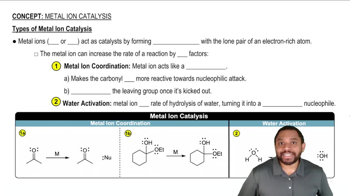
Metal Ion Catalysis Concept 1

Alkylation Reaction

Alkylation is a chemical reaction where an alkyl group is transferred to a nucleophile, such as an acetylide ion. This process typically involves the reaction of the nucleophile with an alkyl halide, leading to the formation of a new carbon-carbon bond. Mastery of this concept is essential for predicting the products of the given reactions.
Recommended video:
Guided course
03:19
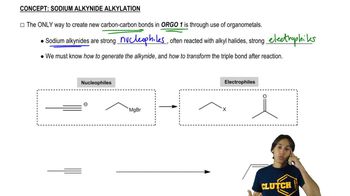
Sodium Alkynide Alkylation

Carbon Count in Products

In organic synthesis, it is important to ensure that the product of a reaction has the correct number of carbon atoms, reflecting the starting materials. This concept involves understanding how the number of carbons changes during reactions, particularly in alkylation, where the acetylide ion adds to the carbon chain of the alkyl halide. Keeping track of carbon counts helps verify the accuracy of the reaction products.
Recommended video:
Guided course
07:07
Electron Counting