Ch. 10 - Alkynes: Electrophilic Addition and Redox Reactions
Mullins - Organic Chemistry: A Learner Centered Approach 1st Edition
Mullins1st EditionOrganic Chemistry: A Learner Centered ApproachISBN: 9780137566471Not the one you use?Change textbook
Chapter 9, Problem 43b

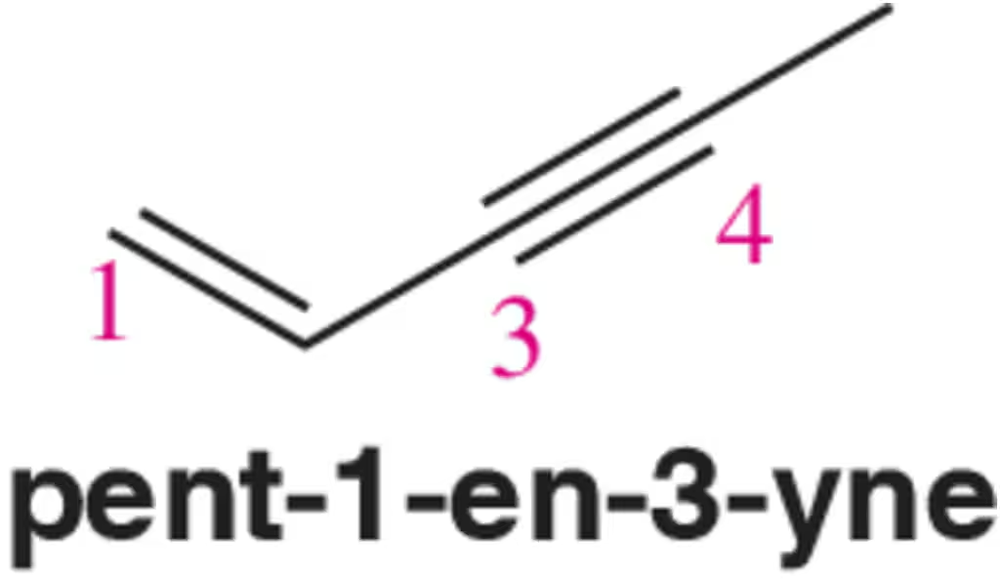
To which carbon would you expect an electrophile to add (1, 3, or 4)? Explain your answer.
Chemical structure of pent-1-en-3-yne with numbered carbon atoms 1, 3, and 4 highlighted for electrophile addition discussion.

Verified step by step guidance
1
Step 1: Analyze the structure provided in the image. The molecule contains two double bonds, one between carbons 5 and 6, and another between carbons 1 and 2. Carbon 3 and carbon 4 are single-bonded carbons connecting these two double bonds.
Step 2: Consider the concept of electrophilic addition. Electrophiles are attracted to regions of high electron density, such as double bonds. The addition of an electrophile typically occurs at the most electron-rich or reactive site.
Step 3: Evaluate the stability of the intermediate carbocation that would form after the electrophile adds. The stability of carbocations is influenced by resonance and hyperconjugation. In this molecule, adding an electrophile to carbon 3 would result in a carbocation that is stabilized by resonance with both double bonds.
Step 4: Compare the reactivity of carbons 1, 3, and 4. Carbon 1 is part of a terminal double bond, which is less stabilized by resonance. Carbon 4 is a single-bonded carbon and does not directly participate in resonance stabilization. Carbon 3, however, is in a conjugated system and can form a resonance-stabilized carbocation.
Step 5: Conclude that the electrophile is most likely to add to carbon 3 because it leads to the formation of the most stable intermediate carbocation due to resonance stabilization with both double bonds.

Verified video answer for a similar problem:

This video solution was recommended by our tutors as helpful for the problem above.
Video duration:
7m
Was this helpful?

Key Concepts

Here are the essential concepts you must grasp in order to answer the question correctly.

Electrophilic Addition

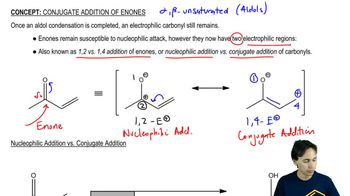
Electrophilic addition is a fundamental reaction in organic chemistry where an electrophile reacts with a nucleophile, typically across a double bond. In this process, the electrophile adds to the carbon atom of the double bond that can stabilize the resulting carbocation. Understanding this mechanism is crucial for predicting the product of reactions involving alkenes and alkynes.
Recommended video:
Guided course
09:23
1,2 vs 1,4 Addition

Markovnikov's Rule

Markovnikov's Rule states that in the addition of HX (where X is a halogen or other substituent) to an alkene, the hydrogen atom will attach to the carbon with the greater number of hydrogen atoms already attached. This rule helps predict the major product of electrophilic addition reactions, guiding chemists in understanding regioselectivity in organic reactions.
Recommended video:
Guided course
03:54
The 18 and 16 Electron Rule

Stability of Carbocations

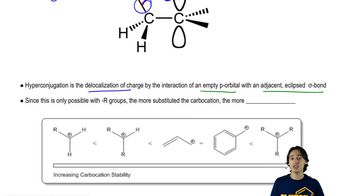
The stability of carbocations is a key factor in determining the outcome of electrophilic addition reactions. Carbocations are positively charged species that can vary in stability based on their substitution; tertiary carbocations are more stable than secondary, which are more stable than primary. This stability influences which carbon atom an electrophile will add to, as the more stable carbocation intermediate is favored.
Recommended video:
Guided course
05:58
Determining Carbocation Stability