Ch. 11 - Properties and Synthesis of Alkyl Halides: Radical Reactions
Mullins - Organic Chemistry: A Learner Centered Approach 1st Edition
Mullins1st EditionOrganic Chemistry: A Learner Centered ApproachISBN: 9780137566471Not the one you use?Change textbook
Chapter 10, Problem 43b

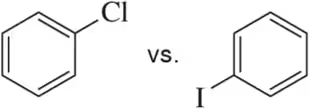
In each pair, choose the compound you would expect to have the highest boiling/melting point.
(b) Chemical structures of chlorobenzene and iodobenzene with a "vs." label, comparing their boiling/melting points.

Verified step by step guidance
1
Step 1: Analyze the molecular structures of the two compounds. Both compounds are halogenated benzene derivatives: chlorobenzene (C6H5Cl) and iodobenzene (C6H5I). The difference lies in the halogen atom attached to the benzene ring.
Step 2: Consider the size and polarizability of the halogen atoms. Iodine (I) is larger and more polarizable than chlorine (Cl). Greater polarizability leads to stronger London dispersion forces, which can increase boiling and melting points.
Step 3: Evaluate the molecular weight of the compounds. Iodobenzene has a higher molecular weight than chlorobenzene due to the heavier iodine atom. Higher molecular weight generally correlates with higher boiling and melting points.
Step 4: Assess the electronegativity of the halogens. Chlorine is more electronegative than iodine, which can influence dipole-dipole interactions. However, in this case, the size and polarizability of iodine dominate the boiling/melting point trends.
Step 5: Conclude that iodobenzene is expected to have the higher boiling/melting point due to its larger size, greater polarizability, and higher molecular weight compared to chlorobenzene.

Verified video answer for a similar problem:

This video solution was recommended by our tutors as helpful for the problem above.
Was this helpful?

Key Concepts

Here are the essential concepts you must grasp in order to answer the question correctly.

Intermolecular Forces

Intermolecular forces are the attractive forces between molecules that influence physical properties like boiling and melting points. Stronger intermolecular forces, such as hydrogen bonding or dipole-dipole interactions, typically lead to higher boiling and melting points. In this case, the presence of chlorine and iodine affects the strength of these forces due to their differing electronegativities and polarizabilities.
Recommended video:
Guided course
03:01
How Van der Waals forces work.

Electronegativity

Electronegativity is a measure of an atom's ability to attract and hold onto electrons. Chlorine is more electronegative than iodine, which means that compounds containing chlorine can exhibit stronger dipole interactions. This difference in electronegativity can influence the overall polarity of the molecules, affecting their boiling and melting points.
Recommended video:
Guided course
1:47
Electronegativity

Molecular Size and Polarizability

Molecular size and polarizability refer to how easily the electron cloud of an atom can be distorted. Iodine, being larger than chlorine, has a more polarizable electron cloud, which can lead to stronger London dispersion forces. These forces can significantly impact the boiling and melting points of the compounds, especially in non-polar molecules.
Recommended video:
Guided course
08:41
Review of Molecular Orbitals