Ch. 11 - Properties and Synthesis of Alkyl Halides: Radical Reactions
Mullins - Organic Chemistry: A Learner Centered Approach 1st Edition
Mullins1st EditionOrganic Chemistry: A Learner Centered ApproachISBN: 9780137566471Not the one you use?Change textbook
Chapter 10, Problem 16b

Based on the stability of the radicals produced, predict which bond in each pair would have the higher bond-dissociation energy.
(b) Two molecular structures compared: ethyl iodide vs. ethyl chloride, arrows indicate bond-dissociation energy focus.

Verified step by step guidance
1
Understand the concept of bond-dissociation energy: Bond-dissociation energy is the energy required to break a bond in a molecule, resulting in the formation of radicals. The stability of the resulting radicals can influence the bond-dissociation energy.
Identify the radicals formed: When a bond is broken, two radicals are formed. The stability of these radicals is crucial in determining the bond-dissociation energy.
Evaluate radical stability: More stable radicals generally result in lower bond-dissociation energy because less energy is required to form them. Stability can be influenced by factors such as resonance, hyperconjugation, and the presence of electron-withdrawing or electron-donating groups.
Compare the stability of radicals: For each pair of bonds, compare the stability of the radicals formed upon bond dissociation. Consider factors like resonance stabilization, inductive effects, and steric hindrance.
Predict the bond with higher bond-dissociation energy: The bond that forms less stable radicals upon dissociation will have a higher bond-dissociation energy, as more energy is required to break the bond and form the less stable radicals.

Verified video answer for a similar problem:

This video solution was recommended by our tutors as helpful for the problem above.
Video duration:
4m
Was this helpful?

Key Concepts

Here are the essential concepts you must grasp in order to answer the question correctly.

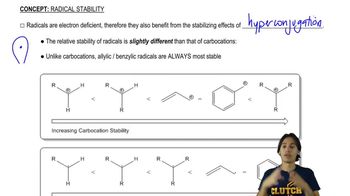
Radical Stability

Radical stability refers to the ability of a radical to exist without reacting further. Stability is influenced by factors such as hyperconjugation, resonance, and the electronegativity of the atom bearing the unpaired electron. More stable radicals are less reactive, which can affect the bond-dissociation energy of the bond from which they are formed.
Recommended video:
Guided course
03:43
The radical stability trend.

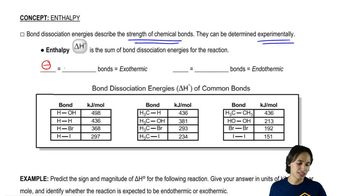
Bond-Dissociation Energy

Bond-dissociation energy is the energy required to break a bond homolytically, resulting in the formation of radicals. It is a measure of bond strength; stronger bonds have higher dissociation energies. The stability of the resulting radicals can influence this energy, as more stable radicals typically result from weaker bonds.
Recommended video:
Guided course
04:09
How to calculate enthalpy using bond dissociation energies.

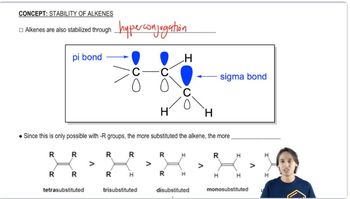
Hyperconjugation

Hyperconjugation is a stabilizing interaction that occurs when electrons in sigma bonds (usually C-H or C-C) delocalize into an adjacent empty or partially filled p-orbital or pi-system. This effect can stabilize radicals by dispersing the unpaired electron's charge, thereby influencing the bond-dissociation energy of the bond from which the radical is formed.
Recommended video:
Guided course
04:28
Understanding trends of alkene stability.