Ch. 11 - Properties and Synthesis of Alkyl Halides: Radical Reactions
Mullins - Organic Chemistry: A Learner Centered Approach 1st Edition
Mullins1st EditionOrganic Chemistry: A Learner Centered ApproachISBN: 9780137566471Not the one you use?Change textbook
Chapter 10, Problem 61

Cyclizations can be carried out under radical conditions involving Bu₃SnH and a catalytic amount of AIBN. Suggest a mechanism for this reaction. [Pay close attention to the bonds formed and broken in developing your mechanism. It may be helpful to number the carbons.]

Verified step by step guidance
1
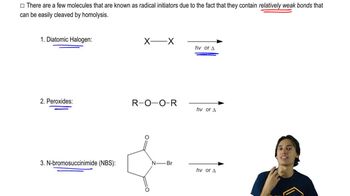
Begin by understanding the role of AIBN (azobisisobutyronitrile) in the reaction. AIBN is a radical initiator that decomposes upon heating to form nitrogen gas and two 2-cyanoprop-2-yl radicals. These radicals are crucial for initiating the radical chain reaction.
The radical chain reaction starts with the generation of a radical from Bu₃SnH. The 2-cyanoprop-2-yl radical abstracts a hydrogen atom from Bu₃SnH, forming a Bu₃Sn radical.
The Bu₃Sn radical then abstracts the bromine atom from the alkyl bromide substrate, generating an alkyl radical. This step is key as it sets the stage for the cyclization process.
The alkyl radical undergoes intramolecular cyclization by attacking the double bond, forming a new carbon-carbon bond and generating a new radical at the terminal carbon of the double bond.
Finally, the newly formed radical abstracts a hydrogen atom from another molecule of Bu₃SnH, completing the cyclization and regenerating the Bu₃Sn radical, which can continue the chain reaction. The final products are the cyclized compound and Bu₃SnBr.

Verified video answer for a similar problem:

This video solution was recommended by our tutors as helpful for the problem above.
Video duration:
10m
Was this helpful?

Key Concepts

Here are the essential concepts you must grasp in order to answer the question correctly.

Radical Reactions

Radical reactions involve species with unpaired electrons, known as radicals, which are highly reactive. These reactions typically proceed through three main steps: initiation, propagation, and termination. In the context of cyclization, radicals can facilitate the formation of cyclic structures by promoting bond formation between carbon atoms, often leading to the closure of rings.
Recommended video:
Guided course
03:49
What are Radical Initiators?

Mechanism of Cyclization

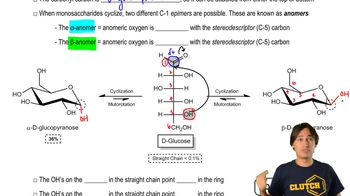
Cyclization refers to the process of forming a cyclic compound from a linear precursor. Understanding the mechanism involves identifying the specific steps and intermediates that occur during the reaction. In radical cyclization, the mechanism often includes the generation of a radical species that attacks another part of the molecule, leading to the formation of new bonds and the closure of the ring.
Recommended video:
Guided course
12:58
Monosaccharides - Cyclization

Catalysis in Organic Reactions

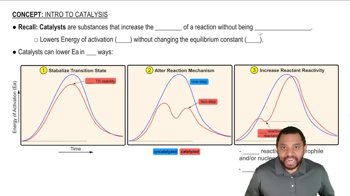
Catalysis involves the use of a substance that increases the rate of a chemical reaction without being consumed in the process. In this case, AIBN acts as a radical initiator, facilitating the generation of radicals necessary for the cyclization reaction. Understanding how catalysts influence reaction pathways and mechanisms is crucial for predicting the outcomes of organic reactions.
Recommended video:
2:10
Introduction to Catalysis Concept 1