Ch. 11 - Properties and Synthesis of Alkyl Halides: Radical Reactions
Mullins - Organic Chemistry: A Learner Centered Approach 1st Edition
Mullins1st EditionOrganic Chemistry: A Learner Centered ApproachISBN: 9780137566471Not the one you use?Change textbook
Chapter 10, Problem 2

Show the transition state of each step of the following alkene addition reaction. Be sure to indicate whether the transition state in each is reactant-like or product-like.
Diagram showing alkene addition reaction with transition states labeled as reactant-like or product-like.

Verified step by step guidance
1
Step 1: Identify the type of alkene addition reaction (e.g., electrophilic addition, hydroboration-oxidation, etc.) and the reagents involved. This will help determine the mechanism and the nature of the transition states.
Step 2: For the first step of the reaction, draw the transition state. This involves showing the partial bonds being formed and broken. Use dashed lines to represent these partial bonds and include any charges or dipoles that develop. Determine whether the transition state is reactant-like or product-like by comparing the energy and structure of the transition state to the reactants and products.
Step 3: Repeat the process for the second step of the reaction. Draw the transition state for this step, again showing partial bonds and charges. Assess whether this transition state is reactant-like or product-like based on the Hammond postulate, which relates the energy of the transition state to the stability of the intermediates or products.
Step 4: Label each transition state clearly, indicating the step it corresponds to and whether it is reactant-like or product-like. Use the terms 'early transition state' for reactant-like and 'late transition state' for product-like, as appropriate.
Step 5: Review the entire mechanism to ensure that all transition states are consistent with the reaction pathway and that the energy profile aligns with the expected energy changes for each step.

Verified video answer for a similar problem:

This video solution was recommended by our tutors as helpful for the problem above.
Was this helpful?

Key Concepts

Here are the essential concepts you must grasp in order to answer the question correctly.

Transition State Theory

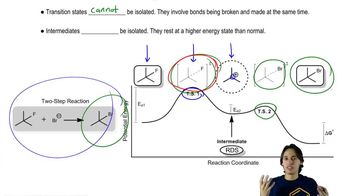
Transition state theory describes the high-energy state that occurs during a chemical reaction, where reactants are transformed into products. This state represents a point of maximum energy along the reaction pathway and is crucial for understanding reaction mechanisms. The transition state is often depicted in energy diagrams and is characterized by partial bonds and unstable configurations.
Recommended video:
Guided course
06:55
Intermediates vs. Transition States

Alkene Addition Reactions

Alkene addition reactions involve the addition of reagents to the carbon-carbon double bond of alkenes, resulting in the formation of saturated products. Common types of addition reactions include electrophilic addition, where an electrophile attacks the alkene, and nucleophilic addition. Understanding the mechanism of these reactions helps in predicting the structure and stereochemistry of the products formed.
Recommended video:
2:35
Addition Reactions of Furan Concept 2

Reactant-like vs. Product-like Transition States

In a reaction mechanism, transition states can be classified as reactant-like or product-like based on their resemblance to the starting materials or the final products. A reactant-like transition state is closer in energy and structure to the reactants, while a product-like transition state resembles the products. This classification helps in understanding the energy profile of the reaction and the stability of intermediates.
Recommended video:
Guided course
01:47
Understanding “like dissolves like”.