Ch. 12 - Substitution and Elimination: Reactions of Haloalkanes
Mullins - Organic Chemistry: A Learner Centered Approach 1st Edition
Mullins1st EditionOrganic Chemistry: A Learner Centered ApproachISBN: 9780137566471Not the one you use?Change textbook
Chapter 11, Problem 11b

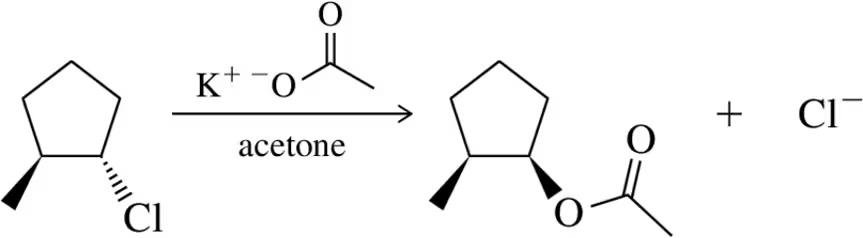
Practice your electron-pushing skills by drawing a mechanism for the following SN2 reactions.
(b) Chemical reaction diagram illustrating an SN2 reaction with a chlorine atom and acetone as reactants, producing a cyclic compound and chloride ion.

Verified step by step guidance
1
Step 1: Identify the nucleophile and electrophile in the reaction. In an Sₙ2 reaction, the nucleophile is typically a negatively charged or lone-pair-bearing species, and the electrophile is the carbon atom attached to the leaving group.
Step 2: Recognize the leaving group. The leaving group is the atom or group that will depart during the reaction. Common leaving groups include halides (e.g., Cl⁻, Br⁻, I⁻) or sulfonates.
Step 3: Draw the backside attack mechanism. In an Sₙ2 reaction, the nucleophile approaches the electrophilic carbon from the side opposite the leaving group. This results in a single-step mechanism where the bond between the nucleophile and the carbon forms as the bond between the carbon and the leaving group breaks.
Step 4: Show the transition state. The transition state in an Sₙ2 reaction is a pentavalent carbon intermediate where the nucleophile and leaving group are partially bonded to the carbon simultaneously. Represent this with dashed lines to indicate partial bonds.
Step 5: Complete the reaction by showing the products. The leaving group departs with its lone pair of electrons, and the nucleophile is now fully bonded to the carbon. Ensure stereochemistry is inverted at the carbon center if it is chiral, as Sₙ2 reactions proceed with inversion of configuration.

Verified video answer for a similar problem:

This video solution was recommended by our tutors as helpful for the problem above.
Video duration:
1m
Was this helpful?

Key Concepts

Here are the essential concepts you must grasp in order to answer the question correctly.

Sₙ2 Mechanism

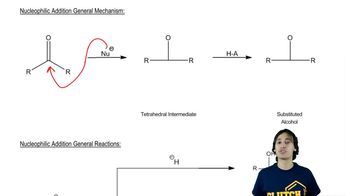
The Sₙ2 (substitution nucleophilic bimolecular) mechanism involves a nucleophile attacking an electrophile simultaneously as the leaving group departs. This concerted process results in the inversion of configuration at the carbon center, making it essential to understand stereochemistry in these reactions. The rate of the reaction depends on both the nucleophile and the substrate, which is why it is classified as bimolecular.
Recommended video:
Guided course
04:32
General Mechanism

Nucleophiles

Nucleophiles are species that donate an electron pair to form a chemical bond in a reaction. They are typically negatively charged or neutral molecules with lone pairs of electrons. In Sₙ2 reactions, strong nucleophiles are crucial as they effectively attack the electrophilic carbon, facilitating the substitution process. Common examples include hydroxide ions (OH⁻) and alkoxide ions (RO⁻).
Recommended video:
Guided course
08:27
Nucleophilic Addition

Leaving Groups

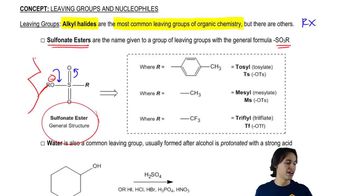
Leaving groups are atoms or groups that can depart from the substrate during a chemical reaction, taking with them the electrons from the bond they formed with the substrate. A good leaving group is typically stable after departure, such as halides (Cl⁻, Br⁻, I⁻) or tosylate (OTs). In Sₙ2 reactions, the quality of the leaving group significantly influences the reaction rate and mechanism.
Recommended video:
Guided course
07:22
The 3 important leaving groups to know.