Ch. 12 - Substitution and Elimination: Reactions of Haloalkanes
Mullins - Organic Chemistry: A Learner Centered Approach 1st Edition
Mullins1st EditionOrganic Chemistry: A Learner Centered ApproachISBN: 9780137566471Not the one you use?Change textbook
Chapter 11, Problem 60a

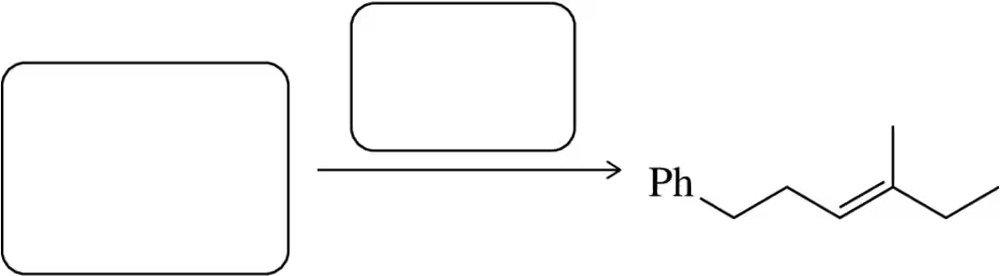
Suggest a bromoalkane and the conditions necessary to produce the alkenes shown.
(a) Diagram illustrating a reaction mechanism with empty boxes leading to a phenyl-substituted alkene product.

Verified step by step guidance
1
Step 1: Identify the alkenes shown in the problem. Determine their structure, including the position of the double bond and the number of carbons in the chain. This will help you deduce the possible precursor bromoalkane.
Step 2: Recall that alkenes can be formed via elimination reactions (E2 or E1 mechanisms). In these reactions, a hydrogen atom and a leaving group (such as bromine) are removed from adjacent carbons to form a double bond.
Step 3: Suggest a bromoalkane that could serve as the precursor. The bromoalkane should have the bromine atom attached to a carbon adjacent to the carbon that will form the double bond in the alkene. For example, if the alkene has a double bond between C2 and C3, the bromoalkane could be 2-bromopropane.
Step 4: Specify the conditions necessary for the elimination reaction. For an E2 mechanism, use a strong base such as NaOH or KOH in an aprotic solvent like ethanol. For an E1 mechanism, use a weaker base and heat to promote carbocation formation.
Step 5: Consider regioselectivity and stereoselectivity. If multiple alkenes are possible, the major product will typically follow Zaitsev's rule, where the more substituted alkene is favored. Ensure the conditions align with the desired product.

Verified video answer for a similar problem:

This video solution was recommended by our tutors as helpful for the problem above.
Video duration:
5m
Was this helpful?

Key Concepts

Here are the essential concepts you must grasp in order to answer the question correctly.

Bromoalkanes

Bromoalkanes are organic compounds that contain a bromine atom attached to an alkane chain. They are important intermediates in organic synthesis and can undergo various reactions, such as elimination or substitution, to form alkenes. Understanding the structure and reactivity of bromoalkanes is crucial for predicting the products of chemical reactions.

Elimination Reactions

Elimination reactions involve the removal of atoms or groups from a molecule, resulting in the formation of a double bond. In the case of bromoalkanes, conditions such as strong bases (e.g., KOH or NaOH) and heat can promote elimination, leading to the formation of alkenes. The mechanism often follows either an E1 or E2 pathway, depending on the substrate and conditions.
Recommended video:
Guided course
00:40
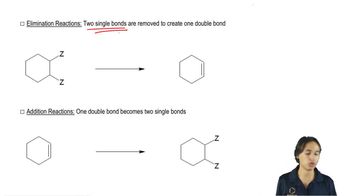
Recognizing Elimination Reactions.

Reaction Conditions

The conditions under which a reaction occurs significantly influence the products formed. For the conversion of bromoalkanes to alkenes, factors such as temperature, solvent, and the presence of a strong base are critical. High temperatures and the use of polar aprotic solvents can favor elimination over substitution, thus promoting alkene formation.
Recommended video:
1:18
EAS Reactions of Pyridine Example 1