Ch. 12 - Substitution and Elimination: Reactions of Haloalkanes
Mullins - Organic Chemistry: A Learner Centered Approach 1st Edition
Mullins1st EditionOrganic Chemistry: A Learner Centered ApproachISBN: 9780137566471Not the one you use?Change textbook
Chapter 11, Problem 15

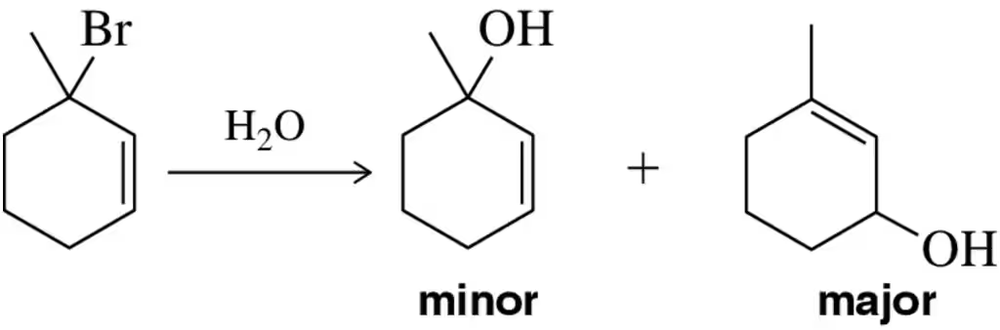
The allylic bromide below gives two SN1 products. Justify the formation of each.
Allylic bromide reacts with water to yield two products, labeled as minor and major, with hydroxyl groups.

Verified step by step guidance
1
Step 1: Recognize that the reaction involves an allylic bromide undergoing an SN1 mechanism. In an SN1 reaction, the rate-determining step is the formation of a carbocation intermediate after the leaving group (Br) departs.
Step 2: Identify the carbocation intermediate formed after the bromine leaves. The allylic position is stabilized by resonance, meaning the positive charge can delocalize over the π-system of the double bond. Write out the resonance structures of the carbocation to show the delocalization of charge.
Step 3: Analyze the nucleophilic attack by water (H₂O). Water can attack the carbocation at either of the two resonance-stabilized positions, leading to the formation of two different alcohol products. The attack at the less substituted position leads to the minor product, while the attack at the more substituted position leads to the major product.
Step 4: Justify the major product formation. The major product is favored because the nucleophilic attack occurs at the more substituted carbon, which is more stable due to hyperconjugation and inductive effects. This stability makes the transition state lower in energy, favoring the formation of the major product.
Step 5: Justify the minor product formation. The minor product forms because water can also attack the less substituted carbon of the carbocation intermediate. Although this pathway is less favorable, it still occurs due to the resonance stabilization of the carbocation, allowing for some distribution of products.

Verified video answer for a similar problem:

This video solution was recommended by our tutors as helpful for the problem above.
Was this helpful?

Key Concepts

Here are the essential concepts you must grasp in order to answer the question correctly.

Sₙ1 Mechanism

The Sₙ1 mechanism is a type of nucleophilic substitution reaction characterized by a two-step process. In the first step, the leaving group departs, forming a carbocation intermediate. The second step involves a nucleophile attacking the carbocation, leading to the formation of the product. This mechanism typically occurs with tertiary or some secondary substrates due to the stability of the carbocation formed.
Recommended video:
Guided course
04:32
General Mechanism

Carbocation Stability

Carbocation stability is crucial in determining the outcome of Sₙ1 reactions. Carbocations are positively charged species that can vary in stability based on their structure; tertiary carbocations are more stable than secondary or primary ones due to hyperconjugation and inductive effects. The stability of the carbocation influences the rate of the reaction and the potential products formed, as more stable carbocations can lead to different nucleophilic attacks.
Recommended video:
Guided course
05:58
Determining Carbocation Stability

Regioselectivity in Nucleophilic Substitution

Regioselectivity refers to the preference of a chemical reaction to yield one structural isomer over others. In the context of Sₙ1 reactions, the formation of different products can occur due to the nucleophile attacking the carbocation at different positions. The regioselectivity is influenced by factors such as sterics and electronic effects, which dictate the most favorable site for nucleophilic attack on the carbocation.
Recommended video:
Guided course
01:47
Nucleophiles and Electrophiles can react in Substitution Reactions.