Ch. 12 - Substitution and Elimination: Reactions of Haloalkanes
Mullins - Organic Chemistry: A Learner Centered Approach 1st Edition
Mullins1st EditionOrganic Chemistry: A Learner Centered ApproachISBN: 9780137566471Not the one you use?Change textbook
Chapter 11, Problem 77

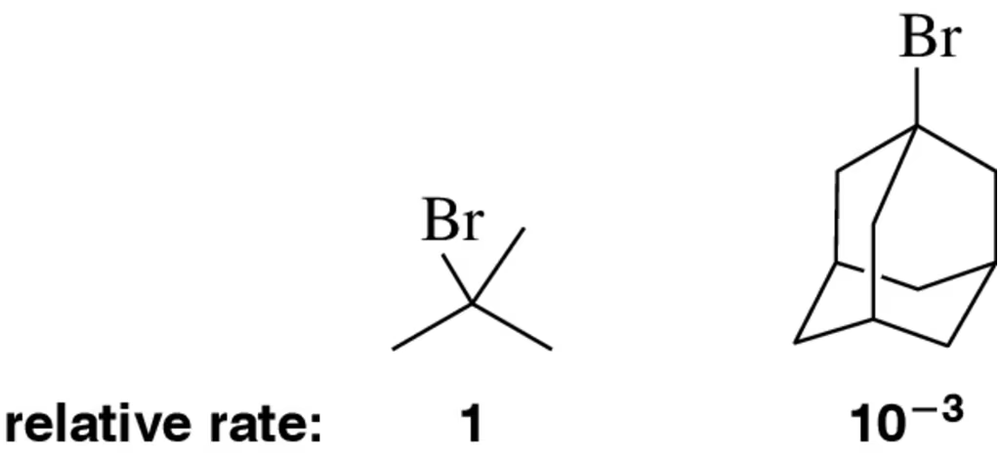
The bromoalkanes shown below participate in SN1 reactions with the relative rates shown. Explain this trend. relative rate:
Bromoalkanes illustrating SN1 reaction rates: one with a relative rate of 1 and another with a rate of 10^-3.

Verified step by step guidance
1
Step 1: Begin by understanding the Sₙ1 reaction mechanism. Sₙ1 stands for 'substitution nucleophilic unimolecular,' which involves two key steps: (1) the formation of a carbocation intermediate after the leaving group departs, and (2) the nucleophile attacking the carbocation to form the final product. The rate-determining step is the formation of the carbocation.
Step 2: Analyze the structure of the bromoalkanes provided. The relative rate of an Sₙ1 reaction is influenced by the stability of the carbocation formed after the bromine atom (leaving group) departs. More stable carbocations lead to faster reactions.
Step 3: Recall the factors that stabilize carbocations. Carbocation stability increases with (1) the degree of substitution (tertiary > secondary > primary), (2) resonance stabilization, and (3) inductive effects from electron-donating groups. Examine the substituents and structural features of each bromoalkane to determine the stability of the resulting carbocation.
Step 4: Compare the relative rates provided with the stability of the carbocations formed. For example, if one bromoalkane forms a tertiary carbocation while another forms a secondary carbocation, the tertiary carbocation will lead to a faster Sₙ1 reaction due to its greater stability.
Step 5: Conclude by explaining the trend in relative rates based on the structural features of the bromoalkanes and the stability of the carbocations formed. Highlight how the leaving group departure and carbocation stability are the key factors driving the observed rates.

Verified video answer for a similar problem:

This video solution was recommended by our tutors as helpful for the problem above.
Video duration:
5m
Was this helpful?

Key Concepts

Here are the essential concepts you must grasp in order to answer the question correctly.

Sₙ1 Reaction Mechanism

The Sₙ1 (substitution nucleophilic unimolecular) reaction mechanism involves two main steps: the formation of a carbocation intermediate and the subsequent nucleophilic attack. The rate of an Sₙ1 reaction depends primarily on the stability of the carbocation formed, which is influenced by factors such as the degree of substitution and resonance stabilization.
Recommended video:
Guided course
02:16
Heck Reaction Mechanism

Carbocation Stability

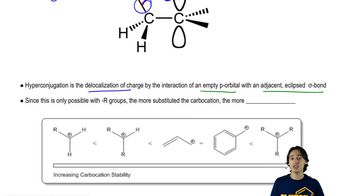
Carbocation stability is a crucial factor in Sₙ1 reactions, as more stable carbocations lead to faster reaction rates. Stability increases with the degree of alkyl substitution (tertiary > secondary > primary) and can also be enhanced by resonance effects, where adjacent double bonds or lone pairs can delocalize the positive charge.
Recommended video:
Guided course
05:58
Determining Carbocation Stability

Nucleophilicity

Nucleophilicity refers to the ability of a nucleophile to donate an electron pair to an electrophile. In Sₙ1 reactions, while the nucleophile's strength is less critical than in Sₙ2 reactions, the nature of the nucleophile can still influence the overall reaction rate, particularly in the second step where the nucleophile attacks the carbocation.
Recommended video:
Guided course
08:27
Nucleophilic Addition