Ch. 13 - Alcohols, Ethers and Related Compounds: Substitution and Elimination
Mullins - Organic Chemistry: A Learner Centered Approach 1st Edition
Mullins1st EditionOrganic Chemistry: A Learner Centered ApproachISBN: 9780137566471Not the one you use?Change textbook
Chapter 12, Problem 73a

Identify the alkene and alcohol partners that could be used to make the following ethers.
(a)

Verified step by step guidance
1
Examine the ether structure provided in the image. The ether has an oxygen atom bonded to two different carbon groups: a phenyl group and an isopropyl group.
To synthesize this ether, consider the Williamson ether synthesis, which involves an alkoxide ion reacting with a primary or secondary alkyl halide. Identify the two parts of the ether: the phenyl group and the isopropyl group.
The phenyl group can be derived from an alcohol, specifically phenol (C₆H₅OH), which can be deprotonated to form the phenoxide ion (C₆H₅O⁻). This will act as the nucleophile in the reaction.
The isopropyl group can be derived from an alkyl halide, such as isopropyl bromide (C₃H₇Br). This will act as the electrophile in the reaction.
Combine the phenoxide ion with the isopropyl bromide in a nucleophilic substitution reaction to form the ether. The phenoxide ion attacks the electrophilic carbon in the isopropyl bromide, displacing the bromide ion and forming the ether linkage.

Verified video answer for a similar problem:

This video solution was recommended by our tutors as helpful for the problem above.
Was this helpful?

Key Concepts

Here are the essential concepts you must grasp in order to answer the question correctly.

Ethers

Ethers are organic compounds characterized by an oxygen atom connected to two alkyl or aryl groups. They can be synthesized through various methods, including the reaction of alcohols with alkenes in the presence of an acid catalyst. Understanding the structure and reactivity of ethers is essential for identifying the appropriate alkene and alcohol partners for synthesis.
Recommended video:
Guided course
04:22
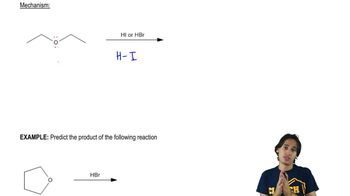
How to predict the products of Ether Cleavage.

Alkenes

Alkenes are hydrocarbons that contain at least one carbon-carbon double bond, making them unsaturated. Their reactivity is primarily due to this double bond, which can participate in various reactions, including electrophilic addition. Recognizing the structure and reactivity of alkenes is crucial for determining which alkenes can react with alcohols to form ethers.
Recommended video:
2:09
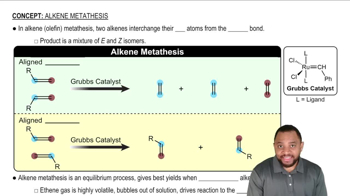
Alkene Metathesis Concept 1

Alcohols

Alcohols are organic compounds that contain one or more hydroxyl (-OH) groups attached to a carbon atom. They can act as nucleophiles in reactions, making them key partners in ether synthesis. Understanding the types of alcohols (primary, secondary, tertiary) and their reactivity is vital for selecting the correct alcohol to pair with an alkene to form a specific ether.
Recommended video:
Guided course
01:01
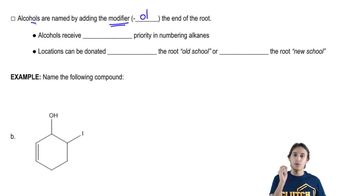
How to name alcohols